Terry Pratchett's Discworld as a Critique of Heroic Fantasy
By Andreas Kristiansen
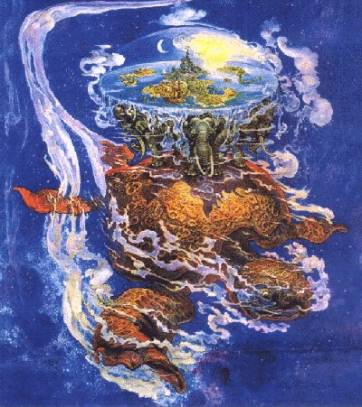
Cover art: Josh Kirby (1928 - 2001)
A Hovedfag Thesis Submitted to the Department of Modern Languages, NTNU, December 2003
Terry Pratchett's Discworld as a Critique of Heroic Fantasy
By Andreas Kristiansen
Cover art: Josh Kirby (1928 - 2001)
A Hovedfag Thesis Submitted to the Department of Modern Languages, NTNU, December 2003
Dedication:
The author would like to thank his supervisor, Professor Jeremy
Hawthorn, for support and valuable comments, and Solvej Todd, who
has now read more about fantasy literature than she ever imagined
she would, for critical input and fantastic cooking.
"'Why does he only lisp the occasional s?' said William, as Igor limped towards a cupboard.
As I was watching television flipping through the channels one night, my eyes were transfixed at the most unlikely of all - Animal Planet. I never watch this channel, but thought for a moment that I recognized Britain's best-selling author, Terry Pratchett. I had only seen his picture on the cover of his books, so I could not be positive. This man seemed very jolly and down-to-earth, spoke with a pronounced lisp and had a strange way of pronouncing his r's. Could this be the same man who in his books gleefully employs speech impediments as jokes and character traits? When it turned out that my assumption was correct, my respect and appreciation for Pratchett somehow magnified. He was obviously not one of those pretentious writers who elevate themselves above the general public through their 'art'. No, I was convinced that this man knew a thing or two about life through bitter experience. The road of his life had not always been strewn with costume-clad groupies, yet his writings leave his readers with the feeling that life is positive and interesting, although it sometimes may seem meaningless and many people are narrow-minded.
Pratchett mocks and laughs at himself as much as he laughs at everyone and everything else. At the same time I could not help feeling that behind the laughter of his words and his fantastical stories there were serious issues hidden. Perhaps there was a world-view behind the dwarfs, dragons and wizards, which aspired to more than laughter. Like all craftsmen of rhetoric - politicians, evangelists, con men - Pratchett has understood that if you get people laughing, they will be more receptive to what you really have to say. If there was a consistent philosophy in his body of work shining through the characters, dialogue, plot and descriptions I wanted to find it. This curiosity resulted in a study of how Pratchett stays within the bounds of Heroic Fantasy while also transcending and subverting it.
Terry Pratchett is a fantasy writer. But he is also a science-fiction writer, a comic writer, and a fiction writer, depending on who we ask and what books we read. On the dust jacket of his 2002 Discworld novel, Night Watch, he is described as "one of contemporary fiction's most popular writers."[2] Fantasy is not even mentioned. Regardless of his popularity as a fantasy writer, or even due to it, it seems that Pratchett feels stigmatized within this box. Upon receiving his first literary award, for a children's book, he commented: "Recent Discworld novels have spun on such concerns as the nature of belief, politics and even journalistic freedom, but put in one lousy dragon and they call you a fantasy writer."[3] In the present thesis I will argue that Pratchett has created (and continuously develops) a new sub-genre that deals more directly with our world than pure Heroic Fantasy does; it is a comic sub-genre that plays with convention, narrative and reader expectation. Within fantasy there exist numerous sub-genres, and the fact that Pratchett creates another one is not in itself remarkable; it is what this sub-genre achieves in relation to the genre of Heroic Fantasy that is striking. I will use the terms 'intradiegetic' (inside the world of the story) and 'extradiegetic' (outside the world of the story) to describe how he constantly moves the reader in and out of the world of the story in relation to the act of reading; the reader is within the world of the story when he is consumed by the narrative and outside the world of the story when the novel reminds her of genre conventions makes him laugh at parallels to her own world. These terms traditionally signify the presence of a narrator in the text, (diegesis = narration), but I also include the effect it has on the reader. Pratchett is a fantasy writer, but that is merely the vantage point from which he observes the world.I will explore the genre of Heroic Fantasy and study how Pratchett diverges from it and borrows from it in his literary world. We will see how his Secondary world is different from other Secondary worlds, and how characters, narrative, plots, language and humor all contribute to create this new sub-genre. Then we can decide what kind of a writer he is, and what type of world-view and values - if any - he is trying to impart to his readers.
On studying introductions and essays Pratchett has written, we notice that he recurrently downplays the role of fantasy as a genre of importance. But he does not dismiss it altogether. Pratchett is balanced about his own work and the need for fantasy:
"Fantasy is like alcohol - too much is bad for you, a little bit makes the world a better place. Like an exercise bicycle it takes you nowhere, but it just might tone up the muscles that will. Daydreaming got us where we are today; early on in our evolution we learned to let our minds wander so well that they started coming back with souvenirs. After all, if we didn't have the ability occasionally to unfocus reality, we'd still be sitting by the ancient river - fearful of the plop."[4]
The purpose of fantasy should therefore not be the reader's total immersion into its various worlds, but the way it contributes to shape us as human beings. It is likewise possible to grow in wisdom and knowledge while being entertained, something Pratchett is a firm believer in. "The best kind of education possible (...) is the one that happens while you think you're having fun."[5] He emphasizes imagination, the importance of dreaming the impossible, and explains why enjoyment of the improbable can propel us to live fuller lives in the realms of the probable. Although Pratchett acknowledges the greater importance of other genres, he still defends the legitimacy of fantasy on the literary smorgasbord. In a comment on Professor John Ronald Reuel Tolkien's achievement in fantasy literature, he says: "At 17, if you don't think The Lord of the Rings is the greatest contribution to literature, there's something wrong with your head (...) If you still think that at 50, there's definitely something wrong with your head."[6] Pratchett seems to imply several points here: he acknowledges the limitations of fantasy, but also the profound positive effect the genre has on younger readers. Fantasy seems to be a way of introducing younger readers to the world of literature. But perhaps he also suggests that as a writer he aims to write more than simply fantasy stories and is attempting to reach beyond the ordinary readership of this genre. In any case, he emphasizes the importance of variation and growth in a reader. An avid reader should read many different types of literature and not be confined to only one genre. The multitudinous references and allusions in his books confirm this attitude to life; the more knowledgeable a person is in all areas, the more she will appreciate the Discworld novels. It should be noted that those among his own readers who were 20 when the first book in the series was published in 1983 are today 40 years of age, and that many of these readers continue to read his books as they grow older.
All writers have certain themes that recur in their work, and obviously some issues are more important to them than others; it is impossible to be a good writer without a strong conviction of some kind. Each writer necessarily contributes values and attitudes to their work, their primary raw material being themselves, in addition to conscious personal observations and meticulous research. Pratchett is no exception, and the impression on the observant reader of the value-judgments scattered throughout his stories is that the are quite deliberate - they are a crucial guide to understanding the deeper significance of Pratchett's novels. It is also necessary to be aware of the influences behind his writing, and the fantasy writers and conventions he is reacting to in his moments of parody. Already it is becoming apparent that Pratchett the author is a prominent presence in his own work. It is almost an impossible task to read the novels without having the author in mind as someone speaking through the narrator, characters and events.
The nature of Pratchett's writing accounts for the seemingly logical problem of both having fantastical influences and reacting to them; upon close inspection he infuses the fantasy worlds of his predecessors with a touch of reality that often makes the opposite statements. Terry Pratchett started out parodying classic fantasy, including Tolkien's The Lord of the Rings trilogy, Fritz Leiber's Lankhmar series featuring Fafhrd and the Grey Mouser, and Anne McCaffrey's Dragonsinger novels, but his targets of parody were not restricted to these three. As the series progressed, his own fantasy invention the Discworld took on a life of its own, where stories unfold that stand well on their own, with a different value system than the one found in Heroic Fantasy. "Pratchett developed a new genre: fantasy that is undercut by reality,"[7] critic Matthew Hills has observed, and I believe Pratchett, like most writers, is concerned with humanity and what it means to be human. To this end he uses humor. "Although [the novels] exist firmly within the fantasy genre (...) they are also critical of its conventions. Pratchett (...) presents a parody of fantasy from within a fantastical landscape."[8] He makes us laugh at others and ourselves simultaneously, showing the folly and inconsistency of human behavior. This inspires an appetite for life, removing feelings of inferiority and insecurity; it displays the psychological effect of comedy. His literature has a unifying function as it brings into the open aspects of life we easily recognize from our own experience but hesitate to talk about out of embarrassment or fear of rejection.
The narrative structure of the Discworld novels is basically the same throughout the series and can be found in the split narrative, a very cinematic device. Except for the first Discworld installment, The Colour of Magic, which had three separate stories, and the Egyptian-inspired Pyramids, none of the other books have chapters; instead scenes are divided by line-space gaps - when the action shifts in space or time, a single line-space gap is inserted into the text as an extra paragraph divider. The narrative technique is of more interest to the Pratchett critic. The author employs an omniscient narrator with a hankering for commenting on events, while seldom providing the whole picture - the reader is often kept in suspense as to how events are linked and what their deeper significance is. I therefore suggest that what we are looking for primarily can be found outside the plots as such, in the interaction between plot and narrator, between character dialogue and reader expectation, between the knowledgeable and the ignorant, the insider and the outsider. All the surprising and comic observations create a reading experience in nature distinctively anti-fantastical.By introducing comical and psychological elements into his fiction - bridging the real world and his fantasy world - Terry Pratchett subverts the genre conventions of fantasy, creating a sub-genre that enables him to criticize the values of modern fantasy from the inside while retaining the fantasy storytelling as an element in his fiction. Furthermore, he also uses comic features in his writing to comment on civilized society, to show readers their human shortcomings and make them able to laugh at themselves.
I will consider elements from three novels - Reaper Man, Guards!Guards! and Thief of Time - from Pratchett's Discworld series in order to study how and why he departs from Heroic Fantasy literature as well as what he is communicating to his readers about our world. I will also refer to some of the other Discworld novels as further evidence during the discussion. Because he is a contemporary and popular author, there is a limited amount of critical material available. The collection of essays Guilty of Literature edited by Andrew M. Butler is the most useful academic volume of criticism on Pratchett's work. I see this shortage as a great challenge as well as an opportunity to contribute to a largely unharvested literary field. I am genuinely fascinated by Terry Pratchett's work, but aim to analyze his work as objectively as possible.
This thesis will be divided into five chapters all dealing with aspects of Pratchett's manipulation of generic conventions, from the first chapter defining Heroic Fantasy and examining its history and the conventions most common to the genre, to chapter five's unveiling of the underlying message of humanity Pratchett is conveying throughout his works. The second chapter, on Secondary worlds, will establish the essence of the Discworld and how it exists simultaneously intradiegetically and extradiegetically in relation to the fantasy genre, the third will deal specifically with Story (in the sense Tolkien used the word)[9], situations and characters, and examine to what degree these factors play a double role in the literature. In chapter four we will study the language itself and how Pratchett uses metaphor and cliché to achieve the same effect. The characterization of Death and the auditors as anthropomorphic entities will also play a large part in this chapter as we study the literalization of metaphor in relation to our theme.
Pratchett uses humor to create a playful approach, but the play is there for a reason. Through his breaking off from set genre conventions emerge values in stark opposition to traditional Heroic Fantasy. Ironically, Pratchett, arguably the most popular contemporary fantasy author, is at odds with most of the fundamental values of Heroic Fantasy. The concluding part of Marcio Kneidinger's Discworld-themed thesis can serve as a starting point for the present study:
"There is the casting of traditional fantasy fiction in a new light, bringing its unrealistic conventions to the reader's attention and highlighting the absence of any recognizable common sense in many of its situations. As the Discworld novels are works of fantasy, Pratchett is criticizing the genre from within, and this is characteristic of both postmodernism and parody in general. "[10]
Kneidinger links Pratchett's work to postmodernism and parody, but although there is pastiche and parody, satire has lately become the prevalent source of humor in the novels.[11] The validity of the above statement will be examined in detail over the course of these pages.
Terry Pratchett was born April 28th 1948 in Beaconsfield, England, and he currently resides in Wiltshire. He is a prolific author with an output of one or two books each year. So far (by November 2003) he has published 45 books, 31 of which belong to the Discworld series. Some of his novels are written for children, (the Bromeliad trilogy Truckers, Diggers and Wings, the Johnny trilogy Only You Can Save Mankind, Johnny and the Dead, and Johnny and the Bomb, and The Last Hero, The Amazing Maurice and His Educated Rodents, and The Wee Free Men, the last three set on the Discworld) always retaining his trademark humor and style. In fact, "Truckers was the first children's book to appear in the British adult paperback fiction best-seller lists, and in due course it was followed by"[12] all his other children's books. He has written two science fiction parodies (The Dark Side of the Sun, Strata), which were early attempts at finding his voice and a setting, two scientific collaborations about the Discworld, (The Science of Discworld, The Science of Discworld II: The Globe), one non-fantasy book about cats (The Unadulterated Cat), as well as collaborating on an encyclopedic guide to the Discworld (The Discworld Companion and the revised The New Discworld Companion). There are also a large number of secondary works connected to the Discworld involving Pratchett to some degree: there are maps, diaries, comics, cartoons, computer games and cookbooks, and every year amateur theatre companies present plays based on adaptations of Discworld novels. It has become an industry with a large fan base, but our focus is the novels, which must be criticized on their independent literary merit.
Pratchett's readership is varied and diverse. His books are popular among computer 'geeks' and teenagers, but "research shows that buyers consist of at least as many middle-aged women as adolescent boys."[13] Although not well known in many academic circles, he holds honorary degrees at two British universities.[14] The acclaimed writer A.S. Byatt is also a professed fan. We all read for different reasons, and we all find different pleasures in what we read. If a teenager reads for the story element, a middle-aged woman for the descriptions of the environment, a student and academic can read it for the multi-layered references, the playful language and the genre experimentation. There is a saying in Britain that no train can leave the station without one person reading Pratchett, testifying to his popularity. When British readers voted for their hundred favorite books in the summer of 2003, the two authors topping the list were Pratchett and Charles Dickens, with five entries each. Fittingly, he has previously been described by critics as "the Dickens of the 21st century,"[15] due to both authors' comedic sensibilities and their realistic descriptions of social, contemporary issues. Perhaps due to this accessibility and enormous popularity, Pratchett has had his share of negative criticism or been plainly ignored, and he seems to get back at his detractors through his own work; in Guards!Guards! he even describes literary critics as parasites inhabiting the hallways of the University library: "[The librarian] waited patiently as a herd of Critters crawled past, grazing on the contents of the choicer books and leaving behind them piles of small slim volumes of literary criticism."[16] How much Pratchett would appreciate a work like the present can therefore be disputed.
"Fantasy is the oldest branch of imaginative literature - as old as the human imagination itself."[17]
"To ask what is the origin of stories (...) is to ask what is the origin of language and of the mind".[18]
The critic Rosemary Jackson writes that "the 'fantastic' derives from the Latin, phantasticus (...) meaning to make visible or manifest. In this general sense, all imaginary activity is fantastic, all literary works are fantasies."[19] Even so, there is a certain type of literature we categorize as fantasy. This genre of modern fantasy is a literature that focuses on Story and contains elements that contradict our experience of what is plausible. Talking animals, magic, supernatural forces, elves and unicorns - all these are examples of typical fantastical elements. There is a variety of sub-genres, such as legend, myth, fairy tale, folk tale, story, fable, parable, dream visions, science fiction, horror and allegories, which facilitate continual generic development. The paramount sub-genre (and what comprises the bulk of modern fantasy) in our discussion is that of 'Heroic Fantasy', a term we will stick to in our discussion, because it is the most common type of fantasy, the starting-point for Pratchett's parody and the genre from which he departs. It is sometimes termed 'High Fantasy', and easily confused with the closely related term 'Sword and Sorcery.'[20] The term 'Heroic Fantasy' was coined by Lin Carter and "emphasizes the conflict between good and evil, and often casts a reluctant protagonist in the role of champion."[21] It involves epic battles between good and evil, often a quest motif, helpers and opponents, a Secondary world with a complete history and distinct landscapes, natural laws with an inherent structure, and fairy tale imaginary creatures like trolls, dwarfs, wizards, witches, elves, and dragons.
"Heroic Fantasy is fantasy about a hero, or heroine, who has sundry adventures in an imaginary world where magic and the supernatural are often encountered. (...) The word 'heroic' should be understood in a wider sense - as not just pertaining to an individual hero, but to a cast of characters, a set of actions, a body of invention and a whole world conceived on a heroic scale. (...) High Fantasy, which is to say Tolkien-esque fantasy, now leads the field: it is simply what fantasy means to most people."[22]
The world of Heroic Fantasy is a place where magic and adventure abound because Story is the all-encompassing concern of the reader. Therefore, narrative interruption or experimentation, which can take the reader out of the story, is generally avoided - the reader must believe in the existence of the world before them and the characters in it. This is the first major convention Pratchett breaks.
Among the various sub-genres a crucial one is the distinction between Heroic Fantasy and Urban Fantasy: "Heroic Fantasy contains more elements of the whimsical along with fantastic creatures and settings, while Urban Fantasy takes place within fantastic elements, but also blends more realistic (and occasionally grimy) elements into the story. Heroic Fantasy frequently uses more archaic or flowery language and terms, while Urban Fantasy uses contemporary speech and even occasional swear words."[23] Pratchett seems to mix the two - he employs elements from Urban Fantasy to parody what appears to be Heroic Fantasy, the end result belonging in neither category. One of the most distinct characteristics of Heroic Fantasy is the fight between good and evil. The genre "offers the reader a glimpse of a world where the verities underlying society endure, where values are strong, (...) where choices between Good and Evil are simpler than in the real world, and where Good may reasonably be expected to triumph in the end."[24] Traces of this can also be found in Pratchett, as the arch of his stories usually ends in a resolution with good triumphant, but we seldom find the clear-cut distinctions between good and evil characters because the battles take place against abstract forces or, more importantly, within characters themselves.
The oral culture of early man ensured preservation of stories as these were passed down from generation to generation. Although we cannot be absolutely certain, "likely the first stories told were fantasies (...) humans must have wondered about the world, its days and nights, seasons and creatures, life, birth, death, luck, love, all the mysteries. They had nothing but imagination to help them try to understand."[25] The stories were either myths to understand the world by, explaining natural forces and other phenomena, or heroic tales designed to teach and prepare the listeners for life. The advent of human consciousness unleashed 'the storytelling ape', and opened the realm of imagination to humankind. The first literary works we are aware of are examples of fantastic fiction, like Gilgamesh, Job, The Illiad andThe Odyssey. Other early works that contain elements of fantasy are Beowolf and the Arthurian legends as well as early novels like Jonathan Swift's Gulliver's Travels and Don Quixote by Miguel de Cervantes Saavedra. We can safely state that "until recent times, fantasy was the mainstream of literature."[26] Interestingly, Peter Hunt points out that what contemporary readers consider fantasy "requires some concept of realism before it can exist."[27] Modern fantasy retained elements of the old style, but sprang out of realist literature as a reaction to it. Hunt goes on to define the place of fantasy in the modern age: "...the modern reader makes categorical distinctions between the possible (real) and the impossible (not-real). Thus fantasy literature set in a Secondary world[28] where the fantastic occurs in believable ways, is a product of the nineteenth and twentieth centuries and should be approached as such."[29] This notion must be linked to the fact that modern readers are very knowledgeable about the make-up of their own world. Even if they were not particularly gullible in ages past, the belief in elves, fairies and others supernatural creatures was prominent. Our perception of the elves changed, asserts Tolkien, "soon after the great voyages had begun to make the world seem too narrow to hold both men and elves; when the magic land of Hy Breasail in the West had become the mere Brazil, the land of red-dye wood."[30] The appeal of and the demand for fantasy literature has increased as the magic of undiscovered places have diminished in the real world.
A distinction should also be made between fantasy and science fiction, a form of literature made popular when Jules Verne started writing about traveling to the moon and going to the centre of the Earth, and H.G. Wells described Martian invasions and time travel. Science Fiction grew out of the heritage of the industrial revolution and the resulting belief in the power of technology, and is "applied to those narratives in which (...) an explicit attempt is made to render plausible the fictional world by reference to known or imagined scientific principles, or to a projected advance in technology, or to a drastic change in the organization of society." It takes place in the future in our planet, in space, or on another planet. Fantasy, on the other hand, is not required to geographically pinpoint the location of its setting, is seldom dystopic[31] or pretending to predict the actual or possible future of mankind, and its symbolism is allusive in favor of immersing the reader in the story. There is a marked difference between these two often confused genres, although instances of genre overlapping have occurred. "The alternative worlds of science fiction (...) seem to be outward-looking, speculative, and consequential. In contrast, fantasy (...) looks inward and backward, as a therapy or a retreat."[32] The defining moment for modern fantasy came when a South African-born British professor of philology began creating a world filled with strange beings and wondrous stories as a venue for his fictitious languages.
There had been fantasy writers (and perhaps more ingenious ones) before Tolkien, but no one defined the modern variant of the genre as profoundly as he did with the release of The Lord of the Rings. He somehow managed to capture the imagination of a wildly diversified group of readers. His goal was to create a mythology for the English people, much as the Scandinavian and the Greek had theirs. In the pursuit of this he drew inspiration from Norse mythology and Wagnerian myth. He invented the concept of 'the Cauldron of Story' in which he asserted that all elements of mythology were assembled in an enormous metaphorical pot waiting for authors to devise their own story mixtures from these elements creating new, powerful stories out of old sources. This partly legitimized his creation while also inspiring other writers of fantasy. The sense of a fully realized Secondary world is what initially draws you into his story, and its creation was long in the making - Tolkien had "been creating Middle-Earth for at least 20 years before he wrote The Lord of the Rings."[33] Its world had been growing in his mind, details developing, and the landscape forming until it was a living entity where he observed as much as he created. The story of a quest with reluctant everyday heroes (the hobbits) as well as proud kings, stately elves, abominable orcs and various kinds of wizards, both of the good and the evil persuasion, laid the ground rules for future fantasy writing in terms of themes and character types. It is an adventure into uncharted waters for any reader, arriving in a world where ancient myth, prophesy and history is felt behind every action and dialogue.
"One of the most striking things about fantasy of the twentieth century is how often it both reflects and transcends its time,"[34] a critic writes. This particularly applies to The Lord of the Rings, and explains why it gained enormous popularity in the latter 1960s becoming a Bible for the hippies accompanying their battle cries for peace in the era of the Vietnam War. The ring was interpreted as the atom bomb and the books read as political commentary. Religious readers also compared Gandalf to Jesus, the ring of power to sin, and so on. This is an important testament to the potency of the trilogy, and to the power of allegory, but the fact is that the quiet Oxford professor detested allegory and often publicly stated that he did not consciously use it in his work. To him, the idea of 'the Cauldron of Story' and the subconscious impact of storytelling were of much greater value, although it cannot be contested that subconsciously his religious values and world-view can be traced in his work. Pratchett would later base his fiction on the standards, types and values that were established by Tolkien and turn them around to create a very different world. Discworld is a place where characters battle an internal fight with the good and evil inside themselves, where war produces more victims than heroes, where confrontation is the last resort, and where all the seemingly insignificant details of everyday life comprise and influence a person's important decisions.
Heroic Fantasy Fiction is a popular genre, a notion which many critics do not find compatible with academic work. However, Tolkien has received serious critical attention internationally as well as having been the subject of several Norwegian Masters' theses in English.[35] Tzvetan Todorov states that "we grant a text the right to figure in the history of literature or of science only insofar as it produces a change in our previous notion of the one activity or the other."[36] In other words, an author and his works are accepted into the canon to the degree of their departure from other texts within the genre. If I am correct in my proposal of Pratchett transcending the generic expectations of modern fantasy, according to the above definition this should grant him a share of academic acceptance. Good literature is obviously not only a matter of genre, but also one of style. Can a popular writer of comedy be worthy of study? Can something entertaining and amusing also contain serious art? The arrival of cultural studies and cultural criticism seems to have rendered the distinction between high and low culture to be less important, and has opened the field of serious study also to popular genres. A particular hindrance for Pratchett in being acknowledged in academic circles may be his focus on comedy, which has historically been avoided as a subject of intellectual pursuit. In Life: The Movie writer Neal Gabler discusses this subject of fun and education:
"Fun was not something much esteemed among intellectuals. The Dutch philosopher-historian Johan Huizinga, in his epochal book Homo Ludens: A Study of the Play-Element in Culture, discovered that the word 'fun' was of recent origin and that no other language had an exact equivalent to the English meaning, leading him to speculate that fun was neither readily understood nor fully accepted until the twentieth century. At the highest level of culture it was taken for granted that good things were serious things."[37]
This notion seems to have prevailed among the intellectual elite, but is it necessarily a correct assumption to believe that 'good things are serious things'? In our postmodern relativist society perhaps one of the most effective means of communicating truth in art is through humor.
It should not matter in what genre of fiction characters are presented as long as there is depth to a work. A central aspect is the presentation of the characters - if they are well-rounded instead of merely stock characters and if they provide original insight into human nature, they can be approved as artistic creations. Additionally, the fantasy genre is one of the few remaining fictional arenas where a degree of innocence is retained - in the description of nature as well as in certain characters. One can easily agree that a canon of valid and important literature should be determined by a group of professionals. There should certainly be a standard of quality on what is taught in public schools and universities, notably within a wide range of genres and subjects. On the other hand, readers give life to literature. Without readers a work loses its vitality. Therefore, an author of popularity ought to be studied in-depth before being dismissed or approved of. Commenting on the quality and reception of contemporary fantasy, Hunt says: "...it is quite certain that the modern fantasy genre contains within it a substantial part of the literary effort and literary skill of present-day English-speaking culture, and provides for millions of readers a distinctive literary reward."[38] The latter is no guarantee of quality, but in line with cultural criticism, it warrants a study on the basis of its popularity alone.
In addition to being the term of a literary genre of the fantastic involving fairy tales and magic, the word 'fantasy' can also mean 'imagination'. The prevailing attitude to the literature of imagination among critics and intellectuals in academic circles is that it belongs to the period of childhood. When we have reached a state of physical maturity, this kind of reading is one of the things we are supposed to have outgrown. The Norwegian science fiction and fantasy pioneer Tor Åge Bringsvæd has written essays about the genre and its place in the literary landscape:
"To me the fable/image/parable is truer than any detailed documentary. Because if reality is a forest we are lost in - and most of us are - it is no good to crouch down and undertake a detailed study of rocks and straw. We probably have a greater chance of knowing where we are if we find a high point. And the fairy tale is exactly one of those trees you can climb. To get a good view. See the big lines in the landscape. (...) Common to all myths is the desire to find a coherence in life."[39] (my translation)
Words like escapism are often used in a derogatory way to describe genre literature generally and fantasy literature specifically. Pratchett retorts: "Jailers don't like escapism."[40] You can of course escape to as well as from.
Just as there is an existential, religious yearning in every human being, there is also a yearning for myth and fantasy. C.S. Lewis, the respected author of the Narnia series, recognized this and asserted a connection between the two. His view was that myth was the human way of dealing with truth too deep to understand with the limited intellect.
"The Fantastical or Mythical is a Mode available at all ages for some readers; for others, at none. At all ages, if it is well used by the author and meets the right reader, it has the same power: to generalize while remaining concrete, to present in palpable form not concepts or even experiences but whole classes of experience, and to throw off irrelevancies. But at its best it can do more; it can give us experiences we have never had and thus, instead of 'commenting on life', can add to it."[41]
When we are kids, almost everything we read and are read to by adults for our enjoyment is some kind of fantasy. Why do most people stop reading this type of literature for their own sake and need an excuse (like children) to start reading it again? Among all literary forms stories, fables and fairy tales are unrivaled as captivators of our whole being; we remember them all our lives and even draw on them in times of need. We harbor an inherent mythological awareness that lies dormant among many adults. Pratchett exploits this awareness by infusing his own work with lessons and details contrary to Heroic Fantasy but which nonetheless are dependent on a mythological awareness concretized by the disruption of generic conventions. [42]
In the latter part of the 20th century, Comic Fantasy developed as a sub-genre of fantasy fiction. "Modern humorous fantasy has become an extensive sub-genre, in which imitation and band-wagon-jumping are rife."[43] As modern fantasy commenced with the publication of The Lord of the Rings, the inception of modern comic fantasy was Bored of the Rings, a parody on the former. Such is the impact and range of Pratchett works that this sub-genre is termed "Pratchettian fantasy" by The Ultimate Encyclopedia of Fantasy.[44] The same work goes on to suggest that "there is a necessary link between humour and high civilization."[45] The Greek Old Comedies, most of which are today lost, except for fragments, was in essence a theatre of fantasy. "Their purpose was not only to provoke laughs, but to comment on the failings of the contemporary world,"[46] and Pratchett continues this approach. Since most comic writers realize that "the humor of parody is rarely sustainable at book length,"[47] the ones who survive also have a story and a message they wish to depart through their humor. "The typical setting is some parodic fantasyland in which themes like quests and the search for plot coupons are spoofed with varying seriousness, and virtually any standard fantasy theme, mythical creature or monster is likely to be sooner or later featured; much depends on the quality of incidental invention."[48] We will study the ramification of this in the chapter on Secondary worlds.
British authors Terry Pratchett, Tom Holt, and Robert Rankin constitute the trinity of contemporary Comic Fantasy authors. To the untrained reader the most obvious trait in Comic Fantasy is that there are no rules, that anything goes, but on closer inspection it is possible to discover that each author establishes his own set of dynamics and barriers within a certain imaginary universe. Tom Holt dabbles in fairy tales, myth and legend - he often mixes a few well-known stories and throws them into utter chaos and unpredictability. "In his books Tom Holt has succeeded in uniting an entertaining tone with a worthwhile content"[49] (my translation). The structural element these authors use is the melding of familiar fairy-tales, creating something new from the familiar, providing unfamiliar setting or adding new contemporary characters to the mix. Set in the sluggish English town of Brentford, the books of Robert Rankin are a never-ending well of occultism, aliens, enigmas, time warps, time travel and mistaken identities. Most of his novels can as easily be classified as science-fiction as fantasy. The pattern Rankin sets up is the extraordinary within the ordinary, and he always includes a credulous explanation of the seemingly incoherent plot.
Comedy is by nature subversive, and Comic Fantasy is indeed the black sheep of High Fantasy with its irreverent tone and unpredictability. The fantasy writer Michael Moorcock is outspoken on the importance of humor. He asserts that a function of humor is to "emphasize the implications of its subject matter, to humanize its characters, clarify its issues and intensify the narrative.[50] (...) A strong sense of comedy or irony in genre writers ensures that their chosen genre (...) never becomes stale and overformalized."[51] In the case of Pratchett, we must even ask the question of whether he can still be counted within the genre. Humor creates a distance to a work which can help readers see themselves. Instead of dismissing comedy as simple and low-minded, Moorcock elevates it to a helpful and effective tool in communicating a message, especially in genres that have a tendency to be overly serious and pretentious, like fantasy. It all rests on the quality and depth of the humor and the skill of the writer. Moorcock also takes a stab at his own genre:
"The great gaudy war-horses of Heroic Fantasy may look very fine in their silks, their cloth-of-gold, their silver, their iron, their richly decorated leather; they may roll their eyes and flare their nostrils and their huge hooves may dance proudly, but they are inclined to shy at the first hint of cannon-fires, to run, clanking and creaking, at the whistle of shot, to whinny in terror at the sight of blood, and return to the safety of their high-fenced field to make somewhat nervous jokes about the real issues not being decided in the mud and filth of the battle - but on some higher, cosmic plane."[52]
Moorcock describes Heroic Fantasy as pompous and in need of a little more realism, which is what Pratchett provides. The irony is that once this happens, the work cannot be called Heroic Fantasy anymore. To change a genre is to distance one's own place in it. Curiously, Pratchett is still sold on the fantasy shelves.
The Discworld has evolved through time as Pratchett has evolved and developed as an author. It is not a static place, but a place overflowing with magic and change. "I guess you could say that the history of the Discworld is my own history as a writer,"[53] Pratchett himself says. What started as a place of pastiche in the first novel grew with each story to become more than a simple parody of a fantasy world, but a canvas on which events, characters, philosophical, religious and political issues could be painted and studied. The Discworld, from its circumfence (the fence that spans the seas around the disc), to the bustling city of Ankh-Morpork, is a giant laboratory for curious writer who does not wish to be limited in his subject matter by any genre stereotypes.
Jen Crowe's thesis entitled A War of Words: Humour in the Works of Terry Pratchett has divided the author's development in terms of humor into three categories: pastiche, parody and satire. "It is useful to think of the spectrum [of comic devices] as having pastiche at one end, parody in the middle and satire at the other end, the various other terms fitting in the spectrum between these major descriptions."[54] The first novel "relies on pastiche because it is easier to start by imitating other people's worlds than it is to develop your own."[55] This stage ends after the first five entries in the series. With Wyrd Sisters, book six, he develops a tone of parody, which incorporates more elements than Heroic Fantasy, and gives his characters more depth. Writes Crowe: "His favourite tool is parody which he displays through the regular juxtaposition of fantasy with pragmatism."[56] Using themes and inspirations from the music industry (Soul Music), the film industry (Moving Pictures), musical theatre (Maskerade), and Red China (Interesting Times), this approach gave Pratchett a framework he could use to reference and relate to his world. Lately he has turned to satire with a more serious tone. The off-hand jokes are not so frequent, and the stories deal with more complex subject matter. This period Crowe sets from the 21st novel Jingo up to the present. Accordingly, of the books in this study, two belong to the middle period of parody, Guards!Guards! and Reaper Man, while Thief of Time is well into the period of satire. We should, however, be aware of the limitations of a categorization like this, as Crowe also recognizes: "Pratchett is never entirely one thing or another, never totally free of pastiche and the burlesque but he can be described as predominantly a writer of pastiche in his earliest writing, mainly a parodist during the middle-age of the Discworld and in his most recent writing (...) he has turned increasingly to satire to fulfill his social commentary."[57] There is a relation between the secondary, physical Discworld and the development of comic devices - it has taken on more dimensions as the writing has progressed. Since it is mainly a world of ideas it is impossible to get a complete mental picture of the disc, but as characters are allowed room to grow areas and nations develop into full-scale entities on the page and in the mind of readers. The Secondary Discworld must be explored in relation to fantasy conventions and original invention.
"Faerie cannot be caught in a net of words; for it is one of its qualities to be indescribable, though not imperceptible"[58]
All writers of fiction use their imagination to invent a world that is to varying degrees like our own. They create in their literature an interpretation of the world they see around them. Realistic writers fashion a universe similar to the one readers know by experience, although it can never be anything but a reading of it, whereas fantasy writers create worlds both similar to and different from ours. "The fantastic involves a clear grasp of reality,"[59] Ingrid Hekneby writes. This is because an imaginary world presupposes and builds on an understanding of the world we live in. Through their imaginary worlds, fantasy writers dream of how they would like our world to be, pinpoint current dangers and shed light on the consequences of actions. This 'escapist' literature thus throws us into a world with its unique problems, and after being a part of the solution, we return to view problems in the real world from a fresh perspective. "When we start telling stories about the universe, the possibility arises of comparing those stories with the universe itself, and refining how well the stories fit with what we actually see."[60] Fantasy stories are about other planets and universes, but as readers compare and contrast worlds the stories can have a meaningful effect on them. It is possible to see Heroic Fantasy literature as a version of the pastoral; it is "a refuge from the troubles and complications of ordinary life where all enmities are reconciled, all problems resolved, and the course of true love made to run smooth."[61] Although there is a great amount of violence and conflict, in the end there is a happy resolution, the saving of the world from evil, or at least the stabilization of events and return to normality. In Pratchett's take on the genre, this predictable outcome is due to the presence of the element narrativium[62], in reality a statement on the human compulsion to think in terms of certain structures. We also see a foreshadowing of this paradisiacal state in some fantasy novels; Tolkien's elfish haven of Rivendell is a place where wounds are healed and peace reigns. On the Discworld there is no such place of perfection - wherever there are people, there are conflicts and issues to be dealt with.
One of the distinctive qualities of fantasy literature is the Secondary world each writer creates. To be a worthwhile literary achievement, the Secondary world needs to possess an internal logic of natural laws, governing bodies, politics and geography. It can be fanciful and different from the one we know, but it has to seem plausible and real. We call it world-building. Geography, weather, history, society, religion, flora, and fauna must all be fitted into the context of the story. There is a great possibility that a fantasy series will be highly valued and cherished if it succeeds in capturing readers' imaginations and makes them believe in its invented world. Because of the otherness of this world, the author is to a high degree responsible for evoking the right tone, setting, and atmosphere through words. If Paris is the setting of a novel, many readers will begin the reading process with knowledge of the city and have assumptions about the setting of the novel before one word is read. The reader may have concrete, personal experiences of geographical places; her senses may remember certain smells and sounds that to him is the essence of Paris. These are both objective and subjective truths. They existed in reality when he experienced them, but she experienced them only subjectively. In other words, the author must relate to a prejudiced reader. She can use this knowledge to create a surprising effect by presenting a different Paris, but she has to be aware of the reader's possible presumption. Authors of fantasy have great freedom to create their world, as long as it is internally coherent, but they must also be aware of certain expectations. Fantasy readers' expectations are shaped by the other works they have previously read in the same genre. Although readers have no real experience with any of these places since they do not exist in objective reality, they have nonetheless experienced them subjectively in their imaginations. They have been to Middle-Earth and they have visited Ankh-Morpork. This is particular to genre fiction like fantasy and science fiction, and it leaves a lot in the hands of the author while giving the readers an opportunity to be co-creators, to invent themselves anew inside this world of pretense. These genres are thus, with their mass of imaginative readers ready for adventure, open to many substandard authors. For a work to retain its magic over time, however, its world must be contained within the pages - a fresh, inspired and fully drawn Secondary world that lives on in readers' minds after the book is closed. "J.R.R. Tolkien was the first to create a fully realized Secondary universe,"[63] a writer comments, and adds: "In contemporary fantasy the setting becomes a character in its own right. It is Tolkien who made it so."[64] The creation of such a powerful world was one of the secrets of Tolkien's success - his readers did not want to leave the beauty, strangeness and terror of Middle-Earth.
Fantasy literature makes readers want to interact with the material, in a large part due to the nature of the Secondary world and the surprises that may be found in it. It is alluring and inviting, because of the element of surprise - what it holds of landscapes, creatures and events is unknown. This does not imply that readers are unable to separate reality from the imaginary, but that experiencing the fantasy world resonates with some need deep within them. Reader-response theory accentuates this meeting of the author and the reader in the text. "...only when the letters are sifted through our eyes and our own mind can they become something more than mouse droppings on white paper (...) a book comes alive in the fellowship between author and reader"[65] (my translation). Fantasy enthusiasts take it one step further as they embark on role-playing in the fantasy environment using characters from their favorite stories. This allows them to become co-authors of new stories with the other players and with the author who originally shaped the characters. (Notice the presence of the three important elements of our discussion, Secondary worlds, characters, and story, and the way they interact.) This accounts for a breaking down of the barrier between the author and the reader. "When two people are discussing a book they have read, we should not assume that they are discussing the same book. Rather: we can be certain they are not" [66](my translation). Through role-playing, the solitary experience of reading is brought into the open. Each individual brings out his interpretation, her experience of the characters and shares it with the others, modifying, challenging and changing perceptions over time as the game and the discussions progress. The Secondary world has an allure, enticing readers to enter it in a more active fashion than is usual for literature.
If Terry Pratchett is to be placed within the fantasy genre at all, certain characteristics must be present in his work. The first of these is a fully realized Secondary world with an internally coherent existence apart from our own. It must in other words be more than a parody of our world. The fantasy critic Peter Hunt remarkably draws parallels between the Discworld and Middle-Earth: "There is little question that Middle-Earth, a complex creation, carefully worked out over many years (...) is the fullest exemplar of the coherent alternative world yet - with the possible exception of Discworld."[67] This is of great value to our discussion, since we hold up Tolkien's work as the standard of modern Heroic Fantasy. In the introduction to The Science of Discworld Pratchett has himself provided a perspective on his Secondary world: "Discworld is a consistent, well-developed universe with its own kinds of rules, and convincingly real people live on it despite the substantial differences between their universe's rules and ours."[68] It is obvious that this is not hard critical evidence, originating from the author, but it is cited here to display his frame of mind on this point.>
From the start, Pratchett wanted to avoid solidifying his fictional world by mapping it. "I've always been mildly against mapping the Discworld. It is a literary construction, not a place."[69] This unwillingness to accommodate one of the most important conventions of fantasy is important. It shows Pratchett's aspirations to lie elsewhere, including his desire to incorporate more than plot in his writing. Where Tolkien started out with languages and maps, Pratchett just needed a place where his various ideas could unfold. However, after the 15th Discworld novel the first map appeared (The Streets of Ankh-Morpork), and so far four maps have been published. This can be the result of giving in to popular demand or commercial interest, but the fact remains that the Discworld was not a mapped-out place from the beginning. It was (and is) a place of ideas, and we must place it somewhere between the fantasy landscape and our world. Lately Pratchett has introduced new characters in other areas of the Discworld, in addition to playing with space/time and vague, fairy land settings (Thief of Time, The Wee Free Men, Night Watch), which demonstrates that he is uncomfortable with the constraint of maps and wants his reader's attention focused on ideas rather than setting and plot.
This puts us in a rather awkward position when we want to classify the Secondary world of the Discworld. Does it have ties to our own world or does it exist independently? Does it exist merely to satirize the world of men, or do the plots and stories have intrinsic and symbolic value beyond that? The answer seems to be both, due to the combination of fantasy and comedy, which are both 'anti-establishment' literary devices in the sense that they rely on defying expectations of reality and containing elements of surprise[70]. In Comic Fantasy the invention is rarely completely original, as authors often set out to mimic and mock other inventions, but sometimes originality can arise from the borrowed, as elements are puzzled together into slightly different shapes.. The Secondary Discworld is both a place in its own right and a place created with the purpose of satirizing our own.
The universe of the Discworld is borrowed from an old Hindu creation myth that tells us how the world is supported by four elephants on top of a giant turtle. Pratchett interprets this literally and creates the flat planet called the Discworld, "world and mirror of worlds, borne through space on the back of four giant elephants that stand on the back of Great A'Tuin the Sky Turtle."[71] In explicitly describing his innovation as 'world and mirror of worlds,' Pratchett acknowledges the dual intention of his writing. On the Discworld we can recognize counterparts of our own world: Ephebe is a version of North-Africa, the Agatean Empire is China, XXXX is Australia and Überwald is a Romanian Transylvania, but Pratchett has claimed that "I've never thought that any parts of Discworld corresponded exactly to places on Earth."[72] Although we recognize these nations' earthly twins, the Discworld nations take on an identity of their own. Indeed, in the fictional segments of the popular science volume The Science of Discworld II: The Globe, the wizards make the following statement when visiting the Earth: "This planet is a cheap parody of our own."[73] This shows Pratchett simultaneously mocking his own invention and drawing links between the two worlds. In devising a fantasy world with so many similarities to our own world, Pratchett is gambling with both the credulity of his world and the possible reader involvement in his narratives: for a story to work as fantasy, it cannot be too closely related to our world (the places must be believable intradiegetically), while for a Secondary world to be believable as satire there must be room for 'coincidences' and events linking the world to our reality. In general, the plot functions as fantasy whereas intradiegetic details and the narrative commentary work to relate it to our world through satire and other comic devices. This is true for the Secondary world of the Discworld on the whole as well. The broad strokes can pass as fantasy, while a closer look at the details unveil something else. The filmmaker Martin Scorsese talks in his documentary series A Personal Journey through American Movies about the director as 'smuggler'. Various controversial, contemporary and sometimes unpopular issues are planted into the medium in a veiled fashion, to avoid scaring of the audience using entertainment to convey serious messages. This can entail plot, symbolism or setting, and the packaging is accessible and appealing, to reach a wide audience. A result of this strategy is obviously the failure to reach every member of an audience, due to various reasons such as motives, and the level of education and perception. This is very much in tune with what I perceive is Pratchett's role in terms of fantasy literature and the genre itself.[74]
The opening image of the universe of the Discworld is an incredible one, but why should we be more amazed at that than by our own blue ball floating in space without any support? In one paragraph about another world, we are encouraged to reflect on the wonders of existence - including the existence of (and on) our own planet. Although there are minor discrepancies in geographical consistency as the series develops, its universe has remained unchanged since its appearance in the first novel:
"Great A'Tuin the turtle comes, swimming slowly through the interstellar gulf, hydrogen frost on his ponderous limbs, his huge and ancient shell pocked with meteor craters. Through sea-sized eyes that are crusted with rheum and asteroid dust He stares fixedly at the Destination. In a brain bigger than a city, with geological Slowness, He thinks only of the Weight. Most of the weight is of course accounted for by Berilia, Tubul, Great T'Phon and Jerakeen, the four giant elephants upon whose broad and star tanned shoulders the disc of the World rests, garlanded by the long waterfall at its vast circumference and domed by the baby-blue vault of Heaven."[75]
Pratchett sweeps the reader from the wide reaches of the cosmos to the inner, not too profound, thoughts of the world turtle. The image of the turtle is astounding, but through it Pratchett has laid the foundation for the double function of his literature: a coherent fantasy world with references to our own. By the time of Guards!Guards!, the 8th novel, the cosmology remains the same, only this time it is so familiar it serves to end the book.[76] Since we are dealing with a world new to us as readers, we must consider how to approach it. Do the same basic rules that we are used to from our own world still apply? Gravity and other basic natural laws exist, but certain other forces are stretched and changed a bit in relation to our preconceived notions. In addition to the unfamiliar but consistent cosmology, the function of light and magic can illustrate two essential differences.
The properties of light and magic seem to be inextricably linked on the Discworld. It would probably be correct to characterize the behavior of light as a function of the presence of magic on the Disc. "Common light undergoes some important changes in the Discworld's vast and ancient magical field (...) When it strikes a mountain range, it piles up on the dawn side, so that dawn will be postponed in the 'light shadow' of the mountain until either the light flows over the top or around the sides."[77] The light is one of many elements which are affected by the presence of magic. It is described in scientific terms, as a "slowly renewing source"[78], a type of energy. "It is subject to certain laws similar to those of the conservation of energy (...) a wizard can rise vertically in the air only by locating a large solid object of similar weight in a high place that can be dislodged without much force, so that the descent of the object propels the rise of the wizard."[79] We can not dismiss events on the Discworld as fanciful or impossible to relate to because of the magical quotient, we are reminded, when many of the devices that assist us in our everyday life are inexplicable to us; "any sufficiently advanced technology looks like magic."[80] There are also many examples of the inexplicable in our world, which we generally explain away or simply ignore.[81] Those instances we term coincidences are on the Discworld attributed to magic. "There is magic in our world, too, but of a different, less obvious kind. It happens around everybody all the time, in all those little causalities which we don't understand but just accept."[82] Worth noting is that magic does not result in a better person or provide an easier life as in much other fantasy literature. On the Discworld magic is not a vague force or a narrative cloaking device, a last resort for a character or the author when logic does not suffice. Rather, the use of magic creates greater problems and is generally avoided Recalling Mickey Mouse's disastrous fight with the brooms in the Fantasia segment The Sorcerer's Apprentice, the scene seems to suggest that you should not tamper with forces you do not master; but when the real magician arrives home he is in complete control. On the Discworld, though, magic is rarely used even by those who master it, because it is strenuous and exhausting, and not at all time-saving. With power comes responsibility, and the University wizards have opted for a minimum of both, at least outside the walls of their own institution. A lot of magic on the Discworld is also attributed an astute practical knowledge of psychology and common sense, primarily in the case of Granny Weatherwax and the witches - what they call 'headology'. There are many kinds of magic, but they all differ from Heroic Fantasy by being explainable either in humanistic or in Discworld-scientific terms. Magic exists, but it has an inner logic. In comparison, "our universe seems to make up its rules as it goes along, unlike the rational, stable universe of Discworld."[83]
Where magic is involved, destruction of some kind is not far off. Magic has a life of its own, and it is not benevolent - it is dangerous to tamper with. A recurring character, Rincewind, a miserable failure as a wizard, is unable to learn any common spells because by accident he managed to get the most powerful spell lodged in his brain and is terrified to let it out. In Soul Music, musical magic takes the form of a guitar and possesses one of the main characters. Any use of magic has an effect beyond the control of the magician; the fabric of reality wears thin and even breaks open. Story climaxes often deal with tentacled, mysterious beings devoid of personality let loose into the Discworld because of careless use of magic. There are always consequences to actions.
The Discworld is a place both familiar and exotic. "Here is a setting where literary genres and social movements can be satirized, gently or savagely, according to need, and where Pratchett's constant linguistic and philosophical awareness, not to say cynicism, can be matched against the 'real' world."[84] The main city of the Discworld, Ankh-Morpork, is a bustling, centuries-spanning version of London, and it is a place were fantasy and reality often come head to head in a battle for supremacy. "In Ankh-Morpork you have what is apparently a Renaissance city, but with elements of early Victorian England and the medieval world still hanging on. It is in a permanent state of turmoil, which is very interesting for the author."[85] You can not get away with clichés or merely elevated rhetoric in this city - what matters are street-smarts and logical thinking. The vampire Otto Chriek explains his disappointment:
"'Veil, you see, if I was to say something portentous like "zer dark eyes of zer mind" back home in Überwald, zer would be a sudden crash of thunder', said Otto. 'And if I vas to point at a castle on a towering crag and say "Yonder is...zer castle" a volf would be bound to howl mournfully.' He sighed. 'In zer old country, zer scenery is phychotropic and knows vot is expected of it. Here, alas, people just look at you in a funny vay.'"[86]
In addition to winking at horror movie stereotypes, this shows the indifference of the big city through the eyes of an immigrant. Everyone is busy, the tempo is hectic, and it is easy to be overcome with feelings of alienation and loneliness. The presence of the city allows the author to deal extensively with the theme of isolation on a personal level, both in secondary characters like the immigrant Otto above and in protagonists like Samuel Vimes who grew up in the city. The setting to a high degree determines the themes, plot and subject matter. Ankh-Morpork not only figures as a large and looming, rather anonymous city, but it takes center stage in many of the Discworld novels. In the sequence of books about the City Watch, beginning with Guards!Guards!, the setting is primarily the city. This is a major departure from Heroic Fantasy, which emphasizes a medieval atmosphere and rural landscapes ripe with adventure. Common denominators are dark forests, deep caves, sea monsters and epic battles. Pratchett instead sprinkles his fantasy with character-driven mysteries, dialogue-centered plots and in-depth studies of civilization. Ankh-Morpork becomes a character in itself, just as important as any fantasy landscape, just as vital as Charles Dickens' London or Paul Auster's New York. On mapping it Stephen Briggs discovered "one of the strengths of Ankh-Morpork in the books, which is that it has a vast bustling civic life that continues quite independently of the activities of the plot-line - it needs brewers, bakers and other tradesmen."[87] It does not simply exist for the sake of some adventure, which gives a sense of reality to the Secondary world.
In Ankh-Morpork we find all types of classes and species; it is a contemporary city with contemporary issues. The Unseen University wizards represent the complacent academics, the Shades is the criminal-infested underbelly of the city, and at the palace the pragmatic Patrician is in charge of the city. Pratchett includes most areas and classes of society, from top to bottom, and often pits them against each other or make them interact, which not only creates comedy but also social commentary. He offers insight into wildly different types and layers of society, and makes the reader accept characters by refusing to fashion them after a conformist generic mold, presenting for example the beggars with a certain dignity in the midst of their lunacy. Commander Vimes is daily exposed to these class distinctions, as his marriage to Lady Sybil takes him from poor boy turned streetwise police officer to a respectable citizen required to wear sequined hats and live in a house full of servants. "...he hated the very idea of the world being divided into the shaved and the shavers. Every time he saw Willikins the butler fold his, Vimes', clothes, he suppressed a terrible urge to kick the butler's shiny backside as an affront to the dignity of man."[88] As he struggles with the reality of where life has taken him, Vimes personifies for the reader a different view of the class struggle - he is a man who has 'made it', but who dislikes his newfound status. Achieving the rags-to-riches myth is perhaps not something to aspire to.
There is also a developed sensibility of racism, prejudice and other social issues present in the novels set in Ankh-Morpork. In Guards!Guards! a female dwarf starts wearing high heels and dresses, and a few novels later the watch is recruiting minority groups like zombies (they claim that really are in majority), werewolves, gargoyles, and trolls by affirmative action. Increasing urbanity leads to intermingling between creatures that normally are enemies, and it sometimes renews age-old enmity - like the relationship between trolls and dwarfs - often with a comic twist. "The Dwarfs have an Equal Heights pressure group and trolls have started the Silicon Anti-Defamation League to beat up people who suggest that, well, trolls beat up people."[89] In a city all the different species are mixed, thus providing a chance of dispelling far-fetched prejudice and unreasonable hatred. In Ankh-Morpork unfounded bias must inevitably be confronted. A troll would rarely meet a dwarf in his home country, and subsequently enmity between them has grown out of proportion. In Ankh-Morpork they see each other every day, and will have to adjust and even to allow some of this prejudice to unravel. The friendship between the troll Detritus and the dwarf Cuddy sets a positive example.[90] The city holds a potential of uniting people, but there is also a correspondent danger of gangs forming and violence escalating. Pratchett repeatedly makes us aware of this and points to desired practical solutions.[91]
On the Discworld, society is developing at break-neck speed. Just like the Roundworld project in The Science of Discworld is a laboratory experiment [92], Pratchett uses the Discworld to mirror and experiment with the technological development of his own world. Sending messages by semaphore has improved long-distance communication, the moon has just been reached, and the newspapers have made their successful entry after the invention of the printing press. The inventions play a prominent part in the plot lines, mirroring the Earth's technological development while arriving at their own unique solutions.
Pratchett has developed many characteristic geographical areas on the Discworld, both rural and urban. The previous example of Otto the vampire shows that rural areas are closer to the classical fairy tale/fantasy setting than urban, and a country like Überwald confirms this suspicion. The witches live in rural Lancre, but most great and disastrous events occur in the city. This is obviously because there are more people in the city on a smaller amount of space. The message seems to be that the potential for both good and evil is found within people. Most city dwellers have an unspoken dream of living in the peace and quiet of the countryside, while they will never be able to give up life in the city. All the three novels we study include a version of this theme: in Guards!Guards! Carrot travels from the mine to the city for the first time and learns its dangers and pitfalls. In Thief of Time Lobsang and Lu-Tze journey on another quest from a Tibetan-like monastery to the city, while in Reaper Man Death retires to a rural village and finds a job on a farm in the harvesting season. The purpose of the rural setting of the latter is primarily to juxtapose it with the other narrative thread of the novel, the urban-set critique of materialism in the form of a fight against invaders shaped like shopping trolleys. Independently of the setting of a conflict, be it urban or rural, we notice that where there are people, there is also the potential of good and evil, and a fight between the two.
Is the Discworld a fully realized Secondary world? Yes and no. It is both a Secondary world and a parody of our own. It takes on a life of its own with unique characteristics, while also staying so close to our world that comparison is inevitable. It makes the links between our worlds more obvious than any other fantasy creation. Unless the story transitions from our world to the fantasy world, making references to our own world at all is indeed contrary to the nature of Heroic Fantasy. The Discworld is intradiegetic and extradiegetic at the same time.
"By now, Discworld is a state of mind. It clearly started as just another medieval fantasy world, but it has evolved (...) Originally it parodied some of the clichés of fantasy writing, and remnants of that style still remain as dandruff on the shoulders of something altogether more worthwhile."[93]
In the next chapter we will focus on some concrete aspects of Pratchett's writing in relation to genre, prominently the depiction of characters, the role of the author, and the effect this has on the reader's awareness of the process of reading.
"For there to be a transgression, the norm must be apparent."[94]
Before we move on, let us summarize the findings of the last two chapters: fantastic literature has deep roots going back to the beginning of human culture. Modern Heroic Fantasy made popular by J.R.R. Tolkien[95] is varied and diverse, but certain themes and devices recur: the quest motif, a full-fledged Secondary world, a reluctant hero, and evil triumphing over good. The language is descriptive, often stilted, the narrator invisible, and the main focus is on the story. Pratchett's Secondary world is a fantasy world in its own right, but it also satirizes and points directly to elements from our own world. At first, this seems contradictory and impossible since "a fantasy is a story based on and controlled by an overt violation of what is generally accepted as possibility".[96] In a genre considered to be subversive in relation to literary fiction, Pratchett, with his constant references to our own world, comes full circle. He subverts (by means of the comic) the subversion (fantasy) through his humor and the way he inserts the smells and sounds of reality into his fantastical environment. "The exploration of what we might expect to be excluded, spaces such as sewers, and Pratchett's construction of an embodied, material fantasy city complete with its decaying and pungent smells and its dirt subverts fantasy's heroic codes and conventions by constantly returning to the visceral state of such a setting."[97] The creation of a fantasy world which constantly reminds readers of the real world by weaving their awareness in and out of the story like a needle composing a quilt of understanding, is the most significant and recurrent theme in Pratchett's body of work and the focus of this thesis. Examples can be found on every page. In ordinary fantasy novels barbarians would remain barbarians, violent and aggressive, but in Pratchett's world the force of city life swallows them up. He reminds us that even the tough guys can get a cold when it rains:
"No enemies have ever entered Ankh-Morpork. This is not entirely true. Technically they have, quite often; the city welcomes free-spending barbarian invaders, but somehow the puzzled raiders always find, after a few days, that they don't own their horses any more, and within a couple of months they're just another minority group with its own graffiti and food shops."[98]
The city has a life of its own which is mightier than any enemy force assimilating eventual conquerors. The city's pragmatic attitude towards theft and begging demonstrated by the presence of the Guilds is also practiced concerning barbarians; the city welcomes them, because they usually bring material valuables and accelerate the circulation of goods. These are economic concerns, and from our own world we can recognize that issues of morality are easily passed over where money enters the equation. When the minstrel of The Last Hero is asked to compose a saga about Cohen and his Horde for a reasonable compensation, this promise of wealth clouds his reason: "These men are rubies insane. They are rubies sure to kill me. Rubies. They've dragged me rubies all the rubies rubies."[99] The truth is that a city's enemies cannot stay enemies for long if they choose to settle there. The dominant element in Pratchett's work can thus be said to be his use of fantasy (settings, plots and characters) to comment upon our familiar everyday reality and world, sometimes doing so directly by alluding and satirizing an earthly counterpart, or indirectly by inherent story-telling. The current chapter will study some aspects of this subversion in-depth. We will see how Pratchett moves the reader inside and outside the story in terms of characters and heroes, the importance of narrativium and the role of the author, as well as the effect of this literary approach on the reader.
In his discussion of genre and slipstream (or interstitial fiction), denoting works of literature that are hard to place in a certain genre, Jed Hartmann writes: "If [fantastic elements] are treated as satire, metaphor, or surrealism, for example, chances are the work will feel more like literary fiction; in science fiction and fantasy, they are more often treated as literal fact in the world of the story."[100] The fact that Pratchett uses a lot of satire and metaphor allowing the reader a distance to the events of the story, contrary to most Heroic Fantasy, seems to suggest that his work can be treated as literary fiction.[101] His work can be perceived as transcending the traditional division between literary fiction and fantasy, as the novels can be placed in both categories; he slips back and forth between engaging story and meta-fiction, placing the readers inside a fantasy narrative before suddenly moving them outside through satire and parody, making them laugh at the conventions they a minute earlier were immersed in. He may very well be the ultimate slipstream author - hard to place because he fits in both (and therefore none) of the categories.
Readers of genre literature have come to expect certain stereotypes and recurrent traits (sometimes called the contract with the reader), which in the long run have the deficiency of rendering the creative process within the reader stale and uninteresting. In his Comic Fantasy, Pratchett is constantly breaking established fantasy plot patterns and expectations. Not only does he interrupt these patterns, but he ridicules and tries them out on characters in the story before he proceeds the next minute to follow the conventions. It is thus impossible to know when he will depart from and when he will fulfill reader expectations, and therefore readers are constantly on the alert. The following passage from Guards!Guards! illustrates the point of using genre expectations to surprise the reader and create a sense of intradiegetic reality to the fantasy story. The characters have concerns and objections which elevate them above mere extras in a fantasy story. A dragon is terrorizing the city of Ankh-Morpork, and Commander Vimes discovers a poster offering a great reward to the dragon slayer; he is anxious to win it. As always, where there is a reward, there is a crowd of people:
"Fifty thousand dollars! An officer of the Watch earned thirty dollars a month and had to pay to have his own dents beaten out. What he couldn't do with fifty thousand dollars...Vimes thought about this for a while and then thought of the things he could do with fifty thousand dollars. There were so many more of them, for a start.
He almost walked into a group of men clustered around a poster nailed to the wall. It declared, indeed, that the head of the dragon that had terrorized the city would be worth A$50,000 to the brave hero that de-livered it to the palace. One of the cluster, who from his size, weaponry and that way he was slowly tracing the lettering with his finger Vimes decided was a leading hero, was doing the reading for the others.
'-to ter-her pal-ack-ee,' he concluded.
'Fifty thousand,' said one of them reflectively, rubbing his chin.
'Cheap job,' said the intellectual. 'Well below the rate. Should be half the kingdom and his daughter's hand in marriage.'
'Yes, but he ain't a king. He's a Patrician.'
'Well, half his Patrimony or whatever. What's his daughter like?'
The assembled hunters didn't know.
'He's not married,' Vimes volunteered. 'And he hasn't got a daughter.'
They turned and looked him up and down. He could see the disdain in their eyes. They probably got through dozens like him every day. 'Not got a daughter?' said one of them. 'Wants people to kill dragons and he hasn't got a daughter?'
Vimes felt, in an odd way, that he ought to support the lord of the city. 'He's got a little dog that he's very fond of,' he said helpfully.
'Bleeding disgusting, not even having a daughter,' said one of the hunters. 'And what's fifty thousand dollars these days? You spend that much in nets.'
'S'right,' said another. 'People think it's a for-tune, but they don't reckon on, well, it's not pension-able, there's all the medical expenses, you've got to buy and maintain your own gear-'
'-wear and tear on virgins-' nodded a small fat hunter.
'Yeah, and then there's . . . what?'
'My speciality is unicorns,' the hunter explained, with an embarrassed smile.
'Oh, right.' The first speaker looked like someone who'd always been dying to ask the question. 'I thought they were very rare these days.'
'You're right there. You don't see many unicorns, either,' said the unicorn hunter. Vimes got the im-pression that, in his whole life, this was his only joke.
'Yeah, well. Times are hard,' said the first speaker sharply.
'Monsters are getting more uppity, too,' said an-other. 'I heard where this guy, he killed this monster in this lake, no problem, stuck its arm up over the door-'
'Pour encourjay lays ortras,' said one of the listen-ers.
'Right, and you know what? Its mum come and complained. Its actual mum come right down to the hall next day and complained. Actually complained. That's the respect you get.'
'The females are always the worst,' said another hunter gloomily. 'I knew this cross-eyed gorgon once, oh, she was a terror. Kept turning her own nose to stone.'
'It's our arses on the line every time,' said the intellectual. 'I mean, I wish I had a dollar for every horse I've had eaten out from underneath me.'
'Right. Fifty thousand dollars? He can stuff it.'
'Yeah.'
'Right. Cheapskate.'
'Let's go and have a drink.'
'Right.'
They nodded in righteous agreement and strode off towards the Mended Drum, except for the intellectual, who sidled uneasily back to Vimes.
'What sort of dog?' he said.
'What?' said Vimes.
'I said, what sort of dog?'
'A small wire-haired terrier, I think,' said Vimes.
The hunter thought about this for some time.
'Nah,' he said eventually, and hurried off after the others.
'He's got an aunt in Pseudopolis, I believe,' Vimes called after him.
There was no response. The captain of the Watch shrugged, and carried on through the throng to the Patrician's palace . . ."
A lot of points can be made about what transpires in this long excerpt. We remember from the last chapter how urban and jaded the people of Anhk-Morpork are, and this is reflected in the bounty hunters' attitude to the dragon. In ordinary fairy tales, like the Norwegian Ash lad stories recorded by Asbjørnsen and Moe[102], we are briefly told of all the failed attempts to win the princess' favor, which are rewarded with lashings and salt poured into the wounds of the suitors. Guards!Guards! represents a critique of this faceless suffering, as the dedication to the bit players in the opening paragraph of the novel makes evident: "...their purpose in any work of Heroic Fantasy is identical: it is round about Chapter Three (...) to rush into the room, attack the hero one at a time, and be slaughtered. No one ever asks them if they wanted to."[103] A similar approach can be found in Austin Powers: International Man of Mystery as the ordinary life of a Bond-inspired anonymous henchman is revealed by the mourning friend played by Rob Lowe.[104] On the Discworld the anonymous players are heard, albeit sometimes briefly, as in the above refusal to kill the dragon.
The above passage is interesting from the point of view of cultural criticism, a theory which is "interested in relating rather than rating cultural products and events."[105] Pratchett is exposing to the readers their own mythical heritage, which is what makes them able to grasp the humor of the passage. The theory of cultural criticism is concerned with the shaping of human consciousness and how it is "forged and formed, to a great extent, by cultural forces;"[106] fairy tales and myths are an important part of childhood, and must therefore have a great effect on human consciousness since it is formed in those early years. The passage makes readers aware of their own expectations, and casts doubts on the logical and moral validity of these expectations. The usually faceless suitors who fail before the hero arrives in this case decide that the reward is not worth the risk. They refuse to take part in the narrative as builders of suspense until the hero comes along. It is significant that characters rebel against their designated role in the story, and in effect proclaim the superiority of the individual. Perhaps the antithesis is not here society per se; the passage can function as a comment on the make-up of a healthy one: in order to produce a functioning society, there needs to be a certain amount of individual freedom.
Pratchett takes a fairy tale/fantasy convention we are familiar with (the reward for the heroic slaying of a dragon) inserting people with sensible and (from the reader's point of view) humorous concerns into the situation instead of stock characters. They display fear, self-consciousness, and common sense - quite the opposite of the heroes of Cohen's horde.[107] But there is also an intradiegetic agenda at work - Vimes is psychologically toying with the bounty hunters because he hope to attain the reward himself. We cannot even know for certain that he is telling them the truth. In other words, the passage makes sense also intradiegetically. The refusal to fight the dragon is not recorded merely in order to make readers laugh at the simplicity of fairy tales - the genre's constant refusal to include logical and obvious objections to conventions and failure to create a psychologically valid setting for its plot and morality lessons[108] - but it is instigated by a character intradiegetically for a real reason. The characters talk about monsters as if these creatures were an everyday occurrence, which seems ludicrous and funny to the readers, but of course to the bounty hunters monsters are ordinary facts of life. Killing fierce and spectacular beings is their line of work, and they have to be concerned with such issues as pension plans and medical insurance; it is a high risk occupation, and they demand to be paid accordingly.
We should also note the pace of the dialogue. Pratchett's main concern is people, how they interact and hide their real intentions behind their actual words, and this is reflected in the amount of dialogue in his work. We find examples of descriptions, narrative passages and ideas in his novels, but the focus is always on people and relationships, primarily shown through dialogue. Most conflicts and issues are solved due to a character's understanding of psychology, instead of through violent confrontation. Even the magic of the Lancre witches is mostly a matter of awareness to detail and psychological 'headology'.[109]
The expectation of the reader is often expressed in the text before it occurs in the plot, often by a character, and thus the author makes the reader aware of these subconscious expectations. The conventions of fantasy are made expressly obvious. This sets up a creative tension - it leaves the reader in confusion as to what will happen next, because it has already been revealed. Since the usual 'surprise' will come as no surprise, will Pratchett include it or not? "'There has to be a secret passage,' she said. 'Otherwise there's no point! She snapped her fingers. 'Of course!' We're doing it wrong! Everyone knows you never find the secret passage by looking for it! It's when you give up and lean against the wall that you inadvertently operate the secret switch!"[110] Even though the predictable storyline sometimes prevails - the characters find a secret passage-way, the reluctant hero saves the day, the dragon is slain - it is not felt as a cliché because Pratchett makes fun of plot conventions along the way. His characters are aware of story-telling conventions and even use them to succeed within the story itself.[111] Pratchett fulfills the genre expectations, but pretends not to during the course of the story. He plays with open cards, so to speak, catering to the media-saturated, well-read postmodern crowd. At least this is what he would lead us to believe. Pratchett exposes the mechanics and stereotypes of fantasy for the entire world to see. In the same breath, he seems to be saying that an author should give his readers more than just the old stereotypes when retelling fantasy staples like the battle between evil and good, because there seldom exists people who are evil to the core. Since "fantasy seems to have, like the folk tales from which it sprang, a restricted number of recurrent motifs and elements: there are young, questing heroes, wise, controlling sages, irredeemably evil monsters, and (although, mercifully fewer these days) damsels in distress,"[112] it is refreshing when someone expands on and exposes these elements. One of the stereotypical heroes in The Last Hero lists the tasks they have to go through and concludes with "...the usual sort of stuff."[113] In other words, this is not the least bit dangerous, because they always pull through and survive. "If you are not going to expect unexpected flames, what's the point of going anywhere?"[114] Living on the edge seems to be the only life that has any appeal to these heroes. Perhaps they are insecure and crave extra attention. Perhaps they cannot deal with a normal life with its more mundane challenges. This treatment of the hero stereotype suggests that the heroic acts in themselves should not be the focus of our interest. Heroic characters like Cohen and his Horde are simple parodies and can not serve as subjects of deep character studies. They have no inner demons to struggle with. The same applies to Rincewind, the parody on the reluctant hero, who is extreme in his reluctance. His solution to any problem or challenge is to run the other way. Readers should be attentive to the interaction between characters, to that which is written between the lines, and to the psychological workings of the story. A real hero has no need to prove his worth by constantly performing heroic and dastardly deeds - his heroism shines through in the menial tasks he performs, because he is intrinsically good, like Carrot, or because he battles his inner demons and comes out on top, like Vimes.
Heroic Fantasy often includes a forgotten king who returns to power after years of obscurity. This can be said to be a legacy of the Arthurian stories where the farm boy is crowned as king after pulling the sword out of the stone. In The Lord of the Rings, Aragorn has lived anonymously and close to nature as the forest ranger Strider for countless years before returning as a warrior to save the kingdom from destruction. The Discworld's Carrot Ironfoundersson never assumes kingly power, although he often saves the city by his natural instincts of leadership as an officer of the watch. In the City Watch books of the Discworld series, constant hints are given about people's willingness to accept a king and about Carrot being a rightful heir to the throne. The readers are still waiting for him to become king, but it will probably never happen - he is far too content in his work as a watchman to aspire to anything 'higher'. In this instance Pratchett does not fulfill expectations, but actively uses them to create tension and suspense, both among his fictional characters and in the readers - intradiegetically and extradiegetically. Awareness of myth is clearly alive also on the Discworld:
"'You saying there's some sort of heir to the throne hanging around somewhere?' said Brother Watch-tower. 'This may be the case, yes.' 'Yeah. They do that, you know,' said Brother Watchtower knowledgeably. 'Happens all the time. You read about it. Skions, they're called. They go lurking around in the distant wildernesses for ages, handing down the secret sword and birthmark and so forth from generation to generation. Then just when the old kingdom needs them, they turn up and turf out any usurpers that happen to be around. And then there's general rejoicing.'"[115]
This conversation taking place at a secret meeting among the 'Elucidated Brethren of the Ebon Night' makes clear what ordinary people expect in terms of a ruler - and the desire for narrative continuum ingrained in us.[116] These comments spring from normal people - here being duped by a power hungry leader - and reveal the hidden awareness of mythology within Discworld characters and their readiness to believe in and expect its reality. "He's generally a swineherd or a forester or similar, your basic skion. It's to do with being in wossname. Cognito. They've got to appear to be of, you know, humble origins."[117]
Interestingly, Thief of Time also utilizes the convention of swineherding, this time pointing to the fact that it is merely a symbol of poor origins and should not only be taken literally:
"'I thought, how does this go, in a myffic kind of way?' Mrs Ogg went on. 'I mean, technic'ly I could see we're in that area where the prince gets brought up as a swineherd until he manifests his destiny, but there's not that many swineherding jobs around these days, and poking hogs with a stick is not all it's cracked up to be, believe you me. So I said, well, I'd heard the Guilds down in the big cities took in foundlings out of charity, and looked after them well enough, and there's many well set-up men and women who started life that way. There's no shame in it, plus, if the destiny doesn't manifest as per schedule, he'd have set his hands to a good trade, which would be a consolation. Whereas swineherding's just swineherding.'"[118]
Once again, we notice the reality of life in the midst of these fantasy surroundings; in real life it is convenient have a back-up plan, and this kind of pragmatic thinking abounds on the Discworld as well. The reference also brings to mind the biblical parable of The Lost Son[119] acknowledging fantasy literature's debt to the old parables. In this passage swineherding takes on the character of metaphor - a metaphor for the menial labor job of the future king while living in obscurity. This is also done for comic effect, but we can recognize the recurrent pattern of Pratchett in its style and deeper significance. This invasion of realism into the realm of fantasy is a significant element in all his fiction.
Carrot is a king on the inside as well as on the outside. When he is first introduced his physical appearance is most prominent, and the kingly sword even appears with him in the first paragraph, signaling his royal heritage.
"The young man is called Carrot. This is not because of his hair, which his father has always clipped short for reasons of Hygiene. It is because of his shape. It is the kind of tapering shape a boy gets through clean living, healthy eating, and good mountain air in huge lungfuls. When he flexes his shoulder muscles, other muscles have to move out of the way first. He is also bearing a sword presented to him in mys-terious circumstances. Very mysterious circum-stances. Surprisingly, therefore, there is something very unexpected about this sword. It isn't magical. It hasn't got a name. When you wield it you don't get a feeling of power, you just get blisters; you could be-lieve it was a sword that had been used so much that it had ceased to be anything other than a quintessential sword, a long piece of metal with very sharp edges. And it hasn't got destiny written all over it. It's practically unique, in fact."[120]
Pratchett uses the sword as a focal point of inserting real concerns into his fantasy literature dispelling the ornaments of genre conventions. Anyone who has tried to hold a sword knows how heavy they are. When you handle it, your hands and body are bound to become fatigued and bruised. This is included in the reality Pratchett often reminds his readers of, which most other works of fantasy overlook. Carrot, at first glance destined to be a king, does not have aspirations in that direction. It is significant, therefore, that readers are given opposing signals as to his inheritance. He was raised by foster parents and received a sword in 'mysterious circumstances', but it is not magical. In comparison, the manufactured sword for the false king has a different and more picturesque appearance:
"It was long and shiny. It looked like something some genius of metalwork - one of those little Zen guys who works only by the light of dawn and can beat a club sandwich of folded steels into something with the cut-ting edge of a scalpel and the stopping-power of a sex-crazed rhinoceros on bad acid - had made and then retired in tears because he'd never, ever, do anything so good again. There were so many jewels on the hilt it had to be sheathed in velvet, you had to look at it through smoked glass. Just laying a hand on it prac-tically conferred kingship."[121]
This is a sword as it would appear in fantasy literature, with the promise of power and fame. But it only has symbolic power - it cannot play its 'destined' part in the realm of the Discworld unless its power is attributed to its psychological effect on people. After thinking about the purpose of kings and swords, one of the other members of the watch squad arrives at some practical truth. "Real kings had shiny swords, obviously. Except, except, except maybe your real real king of, like, days of yore, he would have a sword that didn't sparkle one bit but was bloody efficient at cut-ting things. Just a thought."[122] The realism of Pratchett's fantasy is prominent in every episode continuously upending Heroic Fantasy conventions. True authority according to Pratchett does not appear wrapped in a uniform or in the form of any outward appearance; it has to be found within the person. So when the apparent does not occur to the prospective king himself, it does not matter, because he will always be a king by his behavior and attitude. Throughout the series Carrot is used as a symbol of inherent authority; if anyone would be king, it should be him. He has inner qualities that would be invaluable to a ruler. He has great affection for people and knows everyone in the city by name; therefore everyone respects him and would follow his every command. This is constantly played up and exaggerated in the novels. At the same time he is innocent and naive to the extreme, merely because he always thinks positively about people. Vimes says: "Carrot has charisma. He makes something happen in people's heads. He can talk a charging leopard into giving up and handing over its teeth and doing good work in the community."[123] His respectful attitude to people makes them want to live up to his expectations. History has shown what an evil person with extreme charisma and qualities of leadership can do. This makes us think twice not only about royalty, but more importantly about power, authority and leadership. Pratchett is constantly showing us someone who would be the greatest king in the world, but who does not wish to assume this position. Power corrupts, and it is conceivable that even a good king can be corrupted. "Few civilizations can survive long under an honest, just and strong leader, which is why they generally take care never to elect them."[124] Perhaps it is preferable to have a ruler that does not appear to be intrinsically good - someone everyone knows is chiefly securing his own position. Carrot is one of the more one-dimensional types of heroes. He is too simple to ever become a protagonist, but he serves his function as an inversion of the 'lost king'-stereotype. Other characters are more troubled and multi-faceted, like Sam Vimes.
Pratchett is not very interested in the regular type of hero or the epic fight between good and evil. The conflict he describes is usually against some unknown, impersonal power causing chaos due to the tampering of people,[125] and the struggle takes place just as often within characters as on the battlefield. Cohen the Barbarian and his horde are shallow, mocking stereotypes of the conquering hero, and offer little possibility of in-depth character study. Carrot is too much of a constant joke living in oblivion to appear as a full-fledged character, although he occasionally ponders and worries about his relationship with the werewolf Angua. This is one of the weak points of comic writing - the author and his jokes may be an obstacle hindering character development and reader involvement.[126] The wise monk Lu-Tze of Thief of Time is a self-conscious spoof on the martial arts master/sage figure for the benefit of the readers, winking at us from the pages. When surrounded by a group of hunters, the old monk reminds us of what we expect to happen, although the thugs are not so enlightened: "'What I'm trying to find out here', said Lu-Tze, 'is whether you have any idea what happens when a lot of big armed men try to attack a small, elderly, unarmed monk?' 'To the best of my knowledge,' said the intellectual of the group, 'he turns out to be a very unlucky monk.'"[127] Again, we recognize the presence of intradiegetic and extradiegetic storytelling, and again the matter is one of psychology as we learn how the monk really defeats his assailants. Luck, of course, has nothing to do with it. Lu-Tze is nevertheless such an unlikely hero that he functions more as a joke than as a three-dimensional character. In this he resembles Carrot. Another hero in Thief of Time is the bumbling, but talented teenager Lobsang. Pratchett's true heroes are the anti-heroes, the cowards and the doubters, the clueless and the confused - those who come short in many areas, but still try. Death himself can also be seen as a protagonist anti-hero - we identify with his struggles, and the doubt he must come to terms with is really our own.
Commander Sam Vimes is the most easily recognizable anti-hero - a throwback to the hard-boiled tradition of Chandler and Hammett - in his struggles with alcohol and his deep distrust for the daytime Palace Guard, the official police of the Discworld. Guards!Guards! (as well as the other City Watch books) is equally part detective story and fantasy. During the novels Vimes develops from bachelor to husband and father; he has ascended from a poor upbringing to Captain of the Watch and finally becomes a Lord through marriage. He becomes part of the class he distrusts, and this is only one of the tensions constantly tearing at him. His most enduring struggle is his desire to drink:
"Vimes fumbled his way up the stairs, groped his way into his office, slumped into the primeval leather chair with its prolapsed stuffing, scrabbled at the bot-tom drawer, grabbed bottle, bit cork, tugged, spat out cork, drank. Began his day. The world swam into focus. Life is just chemicals. A drop here, a drip there, everything's changed. A mere dribble of fermented juices and suddenly you're going to live another few hours."[128]
Vimes is an alcoholic, and the first sentence of this passage shows the urgency with which he rips open the bottle to get a drink. The fragmented sentences are choppy, grammatically lacking and almost primitive in their construction. Vimes is a man ruled by these alcoholic urges. In contrast to his seedy L.A. counterparts, Vimes does not resign himself to his fate, but starts fighting back. During the succeeding books, he quits drinking, but is still battling his demons. When his resolve to stay away from liquor is strained to the breaking point, he overcomes temptation because he is surrounded by a network of people: "He knew Carrot and Fred Colon kept an eye on him, but he'd never bought a bottle since he'd got married, because he'd promised Sybil, hadn't he . . . ?"[129] His wife and his colleagues provide him with a reason to live upright, which we seldom find in the classic hard-boiled stories. He is a solid and more positive character than the usual anti-hero, as he would like to one day become a real hero, not by force of brute strength, but due to inner integrity. Despite the troubles of anti-hero Vimes, he is a good cop - the best police officer in the Watch. He is a pragmatist but has no corrupt affiliations to hinder him in his work. He wants criminals to get the punishment they deserve, which sometimes entails holding back his own anger. In what Vimes calls 'the beast' inside himself we recognize the lurking evil in all of us trying to justify wrong behavior. He gets so worked up over criminals that, chased into a corner, his animal survival instinct takes over and turns him into a wild fighting machine. This beast primarily represents the evil inside him, but it also represents the extreme life preservation instinct in all of us. We want to live no matter the cost. Vimes notably struggles with and denies this personal Jekyl room because he will not stoop to the level of the criminals he chases. He refuses to use violence when given the choice, and this sets him apart from the typical protagonist of Heroic Fantasy, who fights to achieve his goals. It is also worth noting, that Pratchett occasionally uses the term 'beast' about a mass gathering of people: "A knot of people would attract other people, and become a bigger, more complicated knot. Carts and sedan chairs would stop to find out what was going on. The invisible beast grew bigger."[130] In a crowd personal accountability dissolves along with important principles like responsibility and honor.
One of the unique elements of the Discworld periodic table is called narrativium. This element is what we wish existed on Earth, something which would make events coherent and give meaning to a fragmented world; we frequently behave as though it were a force governing our lives. "We are the storytelling ape, and we are incredibly good at it. As soon as we are old enough to want to understand what is happening around us, we begin to live in a world of stories. We think in narrative. We do it so automatically that we don't think we do it. And we have told ourselves stories vast enough to live in."[131] Our lives are actually only a heap of individually separated occurrences, but our minds try to tie them together like beads on a string to create the illusion of our lives as a beautiful necklace. Narrativium plays the part we sometimes attribute to God, of overseeing events and possessing the knowledge of a grand plan with our lives. By creating this term Pratchett admits his awareness of conventions and the necessity of them in genre fiction. It is part of the contract with the reader, and the reason why not even he will defy all conventions. Like a natural force, narrativium is beyond the author's control, as it contains all narratives, much like L-space embodies all books present, past and future.[132]
"Admittedly, it has never been isolated on the Discworld either, but its existence had long ago been inferred, as the philosopher Lye Tin Wheedle had put it: 'in the same way that milk infers cows.'(...) It was the glue of the universe, the frame that held all the others, the thing that told the world what it was going to be, that gave it purpose and direction."[133]
The function of this fictitious invisible element in the minds of all men on our planet is a way for us to order our reality, underlining the importance of stories on our world. On the Discworld, narrativium manifests itself in a number of ways, occasionally directing lives and outcomes in a predictable and story-like fashion. When the dragon has invaded Ankh-Morpork and the situation looks desperate, three Guard members are discussing their chances of killing it:
"When you really need them the most," he said, "million-to-one chances always crop up. Well-known fact." "The sergeant is right, Nobby," said Carrot virtu-ously. "You know that when there's just one chance which might just work-well, it works. Otherwise there'd be no-" he lowered his voice-"I mean, it stands to reason, if last desperate chances didn't work, there'd be no ... well, the gods wouldn't let it be any other way. They wouldn't."[134]
Not only do the characters hope for luck, but they rely on narrativium to help them, although they are not able to vocalize or explain its presence. To complicate matters, a lucky arrow is added to the discussion, with the million-to-one chance that it will miss precisely because it is lucky (and therefore likely to happen). In addition they make mathematical calculations on the exact number of chances (merely thousand-to-one versus the magical million-to-one) there are for a certain event to take place. Life is not necessarily simpler with narrativium present, but it is a force that must be reckoned with. In the passage above we again notice that the characters are discussing themselves as if they were in a story, pulling the reader out with them, in this case to ponder their own chances of survival. In other works of fiction, this might be the time for a narrator to pull back from the action and ruminate over the predicament we find the characters in. When done by the characters themselves it creates a peculiar effect, as if they were aware of their lives as characters in a story. The presence of narrativium is a justification for this interweaving of intradiegetic and extradiegetic narratives, a justification of Pratchett's characters' own awareness of story and genre. They lead their serious lives intradiegetically, but since they live in a world where story is the ruling principle, they can also withdraw and study themselves as partakers in a story in order to determine their best course of action in a certain situation. With the introduction of narrativium Pratchett connects the two worlds of fantasy and anti-fantasy that he has set up. It is perhaps not strictly necessary or particularly logical, but it is nevertheless a link which shows his awareness of the paradox of the novels.
It should be noted that the arrow misses the dragon. But although narrativium does not always guide events the way the involved parts expect it to, the fact that the characters are having the discussion in the first place testifies to its vitality. There is room for surprise even in a world governed by the principles of story, because one of the principles of an engaging story is the element of unpredictability. "Fortunately, the chances of anyone surviving the en-suing explosion were exactly a million-to-one."[135] Narrativium saves them, but not in a way they planned. Since readers already know the reason why events happen, the suspense therefore lies in how they will unfold. This focusing on one ordinary idiom or cliché (here: 'million-to-one chance'), and bouncing it around in various ways within the plot is typical of Pratchett, and it shows his interest in renewing cliché-ridden and stale language by defying expectations also in this respect. We will return to the matter of language in the next chapter.
The Christian professor and fantasy author C.S. Lewis uses the human need for meaning as one of his chief arguments for God's existence. Pratchett recognizes this need for coherence of meaning as well, and points to the concept of 'Story' as the fulfillment of this need. Story helps us cope with the puzzles of human existence and pulls us together from individuals to a community with shared experiences and thoughts. "...sometimes the mind of the most sensible person encountered something so big, so complex, so alien to all understanding, that it told itself little stories about it instead. Then, when it felt it understood the story, it felt it understood the huge, incomprehensible thing."[136] The way to understand something, primarily emotionally, is through stories. But Pratchett can not pass on an opportunity to make the passage more complicated and confusing: "And this, Susan knew, was the mind telling itself a story."[137] Because of the element of narrativium, Story often influences events and takes over the plot, forcing through not only a happy ending but also the inevitable consequences of actions. Terms like fate, predestination and time are always featured in the grand scheme of Pratchett's stories. We see clear examples of this in Soul Music and Mort. An individual is miraculously rescued from dying (in the example below by Death's apprentice, substituting for Death), and the forces of the universe refuse to accept it.
"...the universe knew Keli was dead and was therefore rather surprised to find that she hadn't stopped walking and breathing yet. It showed it in little ways. The courtiers who gave her furtive odd looks during the morning would not have been able to say why the sight of her made them feel strangely uncomfortable. To their acute embarrassment and her annoyance they found themselves ignoring her, or talking in hushed voices. The Chamberlain found he'd instructed that the royal standard be flown at half mast and for the life of him couldn't explain why. He was gently led off to his bed with a mild nervous affliction after ordering a thousand yards of black bunting for no apparent reason."[138]
In matters of life and death there are forces outside the human will that can overtake the minds of men. The passage above is a comment on inexplicable urges seemingly beyond our control. The power of belief is a similar issue which we will deal with in section 4.2. People see what they believe; accordingly, when Death enters a bar, most people do not see him because they have already decided that he does not exist. This is an extreme kind of selective perception which hinders all personal development, and a comment on the lamentable human use of narrativium, employing stories to hide from the uncomfortable facts of life. This is an approach to fantasy by the reader that Pratchett is consistently confronting; he is opposed to all forms of complacency. The use of narrativium makes it possible for Pratchett to provide occasional happy endings while enabling him to explore the human need for meaning and order. We fit the pieces of our lives into a linear structure and add a dose of narrativium to make it more seamless. The position reminds us of the existentialist views propounded by Jean-Paul Sartre, Samuel Beckett and Albert Camus - when there is no narrativium and no God we are responsible to fill our own lives with meaning.
The climax of many of the stories deals with indescribable creatures invading the Discworld from the place Pratchett calls the Dungeon Dimensions. When and where the fabric of reality is thin, they break through and cause havoc and chaos. Inspecting these instances closely, we see that they usually take place where people dream of escaping from their real lives, at times when they do not focus on their own existence. This is an anti-fantasy message in fantasy form. It is a fictional echo of our introductory quotation about too much fantasy not being good for you.[139] It is a warning to get our priorities straight. In Moving Pictures, the creatures from the Dungeon Dimensions use the magic of Holy Wood to break through into the real world of the story.
"Victor looked around him. The rest of the audience were staring at the screen as if they were prepared to remain in their seats for...for...forever (...) Reality was what went on inside people's heads. And in front of him were hundreds of people really believing in what they were seeing. (...) Holy Wood went straight from the eye into the brain. In your heart you thought it was real."[140]
The power of the imagination is given a central place in this passage. What we think and create in our minds becomes real, and the willing suspension of disbelief enhances this feeling of reality. This is therefore a warning to be particular about what you watch, read and dream about, because your version of life is formed by the edition you create in your own consciousness. The passage can be read as an intradiegetic warning about fantasy literature. It regards not exclusively movies or fantasy literature, but everything that removes us from awareness of our real duties. Like Jim in Joseph Conrad's Lord Jim, we destroy ourselves if we live in an internal dream state that does not correspond with the reality of our everyday existence and the achievable. In Reaper Man, the creatures from the Dungeon Dimensions take on the forms of trolleys as they try to sneak into the Discworld. The trolley shapes provoke associations of shopping and materialism, which is another passion that can become an obsession taking the focus off the real values in life. As the climax brings us into a half-finished shopping mall with "moving stairs"[141], "music that seems to come from nowhere, "shadowless light"[142] as well as "colour and glitter"[143], it is obvious that our mall culture is one of the targets of the novel. The wizards have never seen anything like it, and do not feel comfortable in it, but the readers recognize it and are given the chance to perceive and feel the shopping culture we have created from their outside point of view. The anonymous forces of the Dungeon Dimensions represent passivity, that which distracts people from creating lives invested with meaning. Movies and TV can easily steal our time if we are not careful, and a life centered on material possessions also leads to neglect of real values. Tellingly, the other main narrative strain in Reaper Man takes place in an anonymous village in the countryside where time is a resource and life is simpler. However, this setting is used mostly for contrast, because investing a life with meaning is a matter of personality and is achievable independent of the setting.
In most of Pratchett's novels we recognize a structural pattern in the plot. There is the introduction of the characters, the mysterious incidents, the building up of the conflict, the climax and the resolution. There is always a battle of epic proportions, in accordance with fantasy conventions, although it sometimes occurs on a personal and symbolic level. Reaper Man portrays two climaxes, one where Death as Bill Door takes on the new death, his own mortality, and time itself.[144] The other involving the wizards and the Fresh Start Club in the giant underground shopping mall portrays the terrifying results of the absence of Death. In Thief of Time the climax deals with time as Lobsang races to stop the building of the clock that will measure the universal tick, while the climax of Guards!Guards! displays the swamp dragon Errol's fight against the dragon king. What these climaxes have in common is a desperate fight against seemingly insurmountable odds and the victorious outcome of the conflict. This is expected from fantasy. What is surprising is neither the fights nor their results - the contrast to Heroic Fantasy is provided in the attitude of the characters during the climax as well as in the narration. Readers are indirectly reminded of the process of reading and of the fictional character of the story, and this brings them outside the intensity of the situation, waking them up from the suspension of disbelief, so to speak. At times the reader is more emotionally involved than the characters themselves, and this creates a tension in the reading process. The engaged reader must struggle with the narrator's tendencies to meta-fiction and decide where to put his focus. To understand the intention and nature of the double role of Pratchett's fiction we need to investigate how this tension corresponds with keeping the readers emotionally involved in the story.
The reader's willing suspension of disbelief is constantly tried and tested in Pratchett's work. One is often reminded of the work's existence as fiction by characters' references to fairy tales and fantasy conventions as well as by the narrator's explicit use of literary terms, and this jeopardizes the reader's emotional involvement in the story. The texts are examples of meta-fiction, defined as "novels which depart from realism and foreground the role of the author and reader in inventing and reinventing the fiction."[145] The novels can be read on many different levels depending on the reader's maturity and interests, and the reader must make a decision where to put the focus: on the story itself, on the meta-references among the characters, on the narrator's interruptions of the story, or on the effect of the various comic devices saturating the novels. The dark and involving aspects of the work will immediately fade as the reader turns the attention to the meta-references, whereas the excitement and suspense will be more consuming if these references are treated as intradiegetical due to narrativium, but the story-aspect can never be completely ignored. Allusions and references can be overlooked, but the story is always in the foreground, as in all fantasy. On the other hand, only a very inexperienced reader will miss the meta-references to genre and expectations, and to overlook this aspect would be to remove a lot of the deeper significance of the work. This aspect may even be so prominent as to be impossible to ignore, especially for a well-read adult reader. The more layers a reader discovers, the more enjoyable the reading process becomes, and the layers comprise a greater understanding of the work, all existing in the mind of the reader at the same time.
The author seems to treat his work as a performance casting himself in the starring role. We can attribute this to the nature of comedy, or see it as a conscious determination on the part of Pratchett to be visible through his work. This factor is the reason it has been tempting to make critical statements linking the narrator and the author attributing to him values and attitudes prominent in the novels. This is clearly a dangerous supposition, and should generally be avoided, but since Pratchett chooses this textual visibility, it can to a certain degree be defended. The text is a meeting point between the author and the reader, where the two contribute their assumptions and experiences to create something new. Every reading thus renders a new experience, and every reader has a different encounter with the text. Like in any relationship there is always an imbalanced power scale. In the case of Pratchett we can conclude that he is the domineering one: entertaining, telling jokes and stories. But comedy is dependable on a response from the reader in order to complete its function. If no reader finds him funny or understands his references, his project is futile. Reader-Response critics argue that "meaning has no effective existence outside of its realization in the mind of a reader"[146] and that "literary meaning is a function of the reader's response to a text and cannot be described accurately if that response is left out of account."[147] Pratchett's novels also include enigmatic and unexplained events, and this leaves room for the reader to make her own interpretations. Does the strong presence of the author and the recurrent extradiegetic devices have a distancing effect on the reader? Character identification is lessened since readers are always reminded of the characters' intradiegetic existence as fiction. On the other hand, there is room for moments of emotional impact. When the dwarf Cuddy, one of the main characters of Men at Arms, dies[148] it is sad and disturbing, as readers suddenly realize that this comic story-world does not protect anyone from danger. Death comes as a shock, as it does in real life. The impact upon the reader may even be greater because of the element of surprise, because intradiegetic emotional moments are far apart. It is not dwelled upon in the example quoted above either, but it is the troll Detritus who displays a deep grief, in conjunction with the novel's theme of racial integration and prejudice. In the novels, the emotional and intellectual impact is generally found in the symbolic and pervading presence of Death and in scattered comments of the narrative, rather than in the action itself. But it is Pratchett's playful approach that must be considered to be the most obvious and recognizable trait of his writing.
A way of understanding the duality of Pratchett's work in terms of genre is by scrutinizing the concept of the reader. Since "literature is a sequence of events that unfold within the reader's mind,"[149] we can assume that the intended reader the narrator addresses is another entity than the real reader holding the book in her hands. We call him the mock reader, "a role that the real reader is invited to play for the duration of the novel. (...) [it] directs attention away from the text and toward the effect it produces."[150] We can also call her the narratee. Both of these terms describe the fictional entity that arises when readers consciously enter a work of literature. "The portrait of the narratee emerges above all from the narrative addressed to him."[151] In the figure designed to illustrate this process (see below), the mock reader is placed within the fictional world of the story. The real reader is situated outside the world of the story, aware of the process of reading, separated from the mock reader by the wall of willing suspension of disbelief. The mock reader is torn out of his fictional state by several factors within the narrative itself, which we call 'distancing effects', all contradictory to the reader's expectations from fantasy literature. (The reader used to Pratchett's playful style will of course have other expectations than the first time reader and the effect may be less on him, but she will still be torn between the two possible states of reading.) These distancing effects are important attributes of the novels discussed in this thesis. Most notably are the meta-references, both related to our own world and to storytelling itself (1 and 2). Linked to this are the references characters make to fantasy conventions inside the fictional work, as if being aware of their existence as characters in a story, explained internally by the presence of narrativium (5). Humor is a factor spanning most of the other ones as it is a subversive device tufted on surprise thwarting reader expectations (4). The way Pratchett uses language also contributes to this shifting state of the work - the language is not archaic and old-fashioned, but rather colloquial and modern, and literalization of metaphors ensures awareness of literary terms, the mechanics of literature.[152] The conscious application of clichés and the self-referentiality of the text make the reader aware of the limitations and nuances of language (3). There is a constant flux in the reader between these two states, as illustrated with the arrows going both ways, which constitutes the tension of Pratchett's literary style.
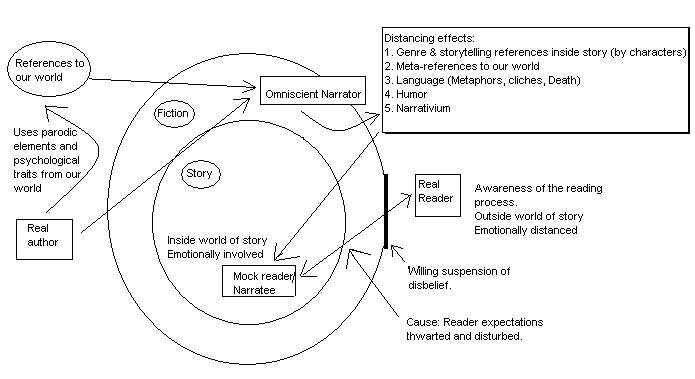
Another matter to consider is the implicit contract between every genre writer and its readers.[153] Is Pratchett guilty of breaking this contract, or does the comedy allow him to make up his own rules? Certainly, fantasy enthusiasts expecting straight fantasy may be disappointed or feel betrayed, but we must remember that genre expectations are also necessary in order to fully understand Pratchett's departure from the genre. Therefore, the readers most likely to enjoy his work in terms of what is being spoofed are identical with the consumers of the source material. In the process they are taught the value of self-mockery, of not taking oneself too seriously.
The inherent mythological aspect of the human consciousness is made evident and challenged in the Discworld series. In the long passage above about the risks and rewards of killing the dragon, Pratchett, a popular author belonging to low culture (using terminology from cultural criticism), paraphrases Voltaire, an author and statesman of high culture: 'pour encourjay lays ortras,'[154] a character says, which in the original work in translation means "in this country we find it pays to shoot an admiral from time to time to encourage the others."[155] In addition to adding to the main theme of the novel, which can be described as stressing the value of every individual of society despite status, the allusion mixes high and low culture, and few people but academics would have the necessary knowledge to discover it. The author includes influences from all cultural sources reminding us that the works of deconstructionist critic Jacques Derrida, a forerunner of cultural criticism and post structuralism, has "allowed cultural critics to erase the boundaries between high and low culture."[156] Evidently, without knowledge of the original reference the reader will miss the intention of the author completely. A well-read and educated reader should therefore to a high degree be able to enjoy the novels of Pratchett. Ironically, this is the group of readers that dismiss him due to the fantastic and comedic nature of his work. It should be noted that Pratchett indeed has many readers in academic circles, but it seems that his stories are also enjoyed by younger readers who cannot grasp the full satire and the implications of most references. It would be interesting to organize a survey examining the effect of the novels on various readers using reader-response theory in relation to age, gender and education. Do different groups enjoy different levels of the novels? At what age do readers start enjoying the meta-qualities of the work as much as the story? And reversely: to what extent are educated readers emotionally involved with the characters and the plot?
The manipulation of genre conventions was the foundation for the Discworld and Pratchett's career, and can predominantly be found in his early novels along with the 'children's books' such as The Amazing Maurice and his Educated Rodents and The Last Hero. This simplest kind of Pratchett's anti-fantasy style is the pointing out of the obvious flaws of the fantasy genre while writing an engaging story. He takes obvious details from fantasy conventions and plays them up in dialogues and character's attitudes. Their expectations correspondently mirror the expectations of the reader. The characters are representatives of the reader inside the story making sure the narrative moves beyond the predictable - the questions of credibility posed by readers can also be found intradiegetically, within the stories. Most characters are also types, often providing readers with real-life counterparts they can recognize from their own experience. This tapping into the sources of human psychological behavior provides greater amusement and instruction than any exaggeration or fanciful invention could. Another level of distancing is the way Pratchett calls attention to language itself, to the tools of his trade, making the reader sensitive to its purpose and function in the shaping of a story. This is the subject of the next chapter.
"An aphorism is merely a small group of words arranged in a certain order because they sound good that way, but oftentimes people tend to say them as if they were saying something very mysterious and wise." [157]
"A work of fantasy compels a reader into a metaphorical state of mind."[158]
In traditional Heroic Fantasy the language is often grandiose and pompous giving weight to the battles, the gut-wrenching fights and the atmosphere of the surroundings. Pratchett deals with weighty issues like the transience of time, metaphysics and death, but his language is in stark contrast to that of other writers in the genre. His battles take place on an interior, more abstract plane, where language often plays an important part in the struggle itself. The one who masters psychology and rhetoric often triumphs over the proponents of brute force. The current chapter focuses on language and writing, which is the art of combining 26 letters in different ways to create various emotional and intellectual responses in the mind of the reader. This is common to all styles of writing, but fiction, and especially the category of humor, involves a strong element of play, with a focus on the functions of language and not only on the content. It therefore has the same attributes as we have been discussing, coexisting intradiegetic and extradiegetic narrative functions: drawing attention to the process, disrupting the reader's suspension of disbelief while also telling a story. Through the manipulation of language Pratchett makes us aware of the mechanics of literature and challenges conventional wisdom using conventional wisdom for this exact purpose. He invents new words, applies the double meanings of words in puns, and twists familiar phrases to make readers see them in a new light.
In Thief of Time Pratchett inverts expectations by revealing the history monk Lu-Tze's precious 'Book of the Way' as a collection of sayings attributed to Mrs. Cosmopolite, a dressmaker in Ankh-Morpork. Her daily conversation is, like ours, filled with clichés. In our daily life, we talk about the weather, sports, food and movies, and we seldom reach deeper into more personal issues. It is possible to live a whole life without really opening your soul to another person. The people who pursue true wisdom often examine ancient religious texts like The Bible, The Quran and The Bhagavad-Gita, or seek counsel with personal sources of wisdom, such as gurus and sages. A particular type of wisdom can be found in the Buddhist areas of Tibet and in other parts of Himalaya. This wisdom is often delivered in couplets or metaphysical nuggets, and contains obvious statements about life, which we in our hurried lifestyles have forgotten. Is it conceivable that our daily language contains similar wisdom in the guise of clichés?
"'After a lifetime of searching, I saw at last the opening of the way. My way...Thus I met Mrs. Cosmopolite, who opened the door when I knocked and then when I hesitated, not being sure of the language, she said, "I haven't got all day, you know." Almost to a word, one of the sayings of Wen! Instantly I knew that I had found what I was seeking!'"[159]
In the above quotation Pratchett alludes to The Bible signaling the spiritual nature of Lu-Tze's quest. "Seek and you will find. Knock and the door will be opened to you,"[160] Jesus said. By using the phrase 'opened the door' Pratchett indicates that Mrs. Cosmopolite has become the monk's spiritual mentor, but when her wisdom/cliché statement 'I haven't got all day, you know' is uttered in the next line, the readers are brought back to real life and to the fact that a real door in a real house is being held open. His is a quest for a spiritually instructive language and words, and the dressmaker inadvertently becomes his mentor. We also note the connotations invested in mundane actions, such as the act of opening a door. In addition to this, the phrase 'opened the door' is a cliché on a par with 'see the light' in regards to spiritual experiences; Pratchett thus prepares the reader for the theme of cliché versus wisdom by inserting a cliché undercover, so to speak.
In the same sense that human beings hear and see what we hope and expect to perceive, the importance of words depends on who is uttering them. The opinion of a king may have grave importance, while the identical sentence uttered by a chimney sweep may be ignored. People who find a joke told by a famous comedian incredibly funny may not contract one facial muscle if an amateur performer or even someone they dislike tells the same joke. Our preconceptions condition our responses. Here, by sheer coincidence, an ordinary blue-collar dressmaker has unwittingly tapped into the ancient sources of wisdom, but there is not a huge line of people waiting to receive this wisdom. The dilemma the readers are left with is namely this: are clichés and conventional wisdom more potent than we have thought or is the ancient wisdom merely fraud embroidered with flowery language? Either conventional wisdom is elevated to higher wisdom, or so-called higher wisdom is exposed as void of meaning. It is difficult to determine the author's intentions, and we suspect he merely wants us to be aware of the ambiguities and potential of language. We are indeed pointed to an intriguing circle of understanding: the most revered and philosophical utterances are closely related to those which are despised and deemed of little value by literates. The numerous possible manipulations of language, the confusing versus the clarifying, clichés versus wisdom, is obviously a central issue in the novel, for in Thief of Time a monk asks a similar question of his Master: "...what is the difference between a humanistic, monastic system of belief in which wisdom is sought by means of an apparently nonsensical system of questions and answers, and a lot of mystic gibberish made up on the spur of the moment?" [161] The answer is not satisfying, but apparently the question is more important than the answer. A clue in favor of the cliché can be found in Guards!Guards!: "The reason that clichés become clichés is that they are the hammers and screwdrivers in the toolbox of communication."[162] The same way we need to open our eyes to rediscover the beauty of our own world, we must be forced to look behind our attitudes to the clichés so we can rediscover their original meaning. They may not be the most spectacular of literary juggling, but they are necessary for communication to work. And if literature aims to mirror reality, it also needs to include this kind of communication.
Pratchett additionally inverts the rules of appropriate writing in Thief of Time. An author is supposed to avoid clichés, whereas Pratchett scatters them on almost every page of this novel. He makes his readers aware of these condemned clichés, but puts them in a different setting to discover whether they have any potency left. This is left up to the reader to decide. It seems ironic to us that a monk would travel halfway across the disc to find wisdom in a dressmaker's babble. This illustrates the truth of another well-used cliché: 'The grass is not always greener on the other side.' Lu-Tze admits he made the long journey to the city because of this wide-spread attitude; maybe not for his own sake, but in order to do the right thing in the eyes of others: "...one day it seemed to me that everyone had decided that wisdom can only be found a long way off."[163] The inversion of going from the Himalaya-like monastery to the big city in order to discover wisdom is all the more shocking because the monk finds what he is looking for. He finds the wisdom he has known all along through the sayings of Wen. The sense remains that Lu-Tze's 'Book of the Way' is merely for the sake of other people, as was his journey. It is not imperative to go to Himalaya in order to gain wisdom. The paradox is that we will not find what we are looking for unless we already have it in us, and then we can find it independent of our geographic location.
Metaphor plays a large role in Pratchett's novels, both as manifestations come to life through the human imagination, and on the level of literary terms. He often lets characters and the narrator mention the word 'metaphor', showing that they are conscious of the storytelling taking place around them. This does not necessarily indicate their awareness of being part of a story, for they are commenting on the function of metaphor within its confines: "...it's quite straightforward. It's all metaphorical. My senses are telling me stories because they can't cope with what is really happening."[164] The characters discover intradiegetically the human need for metaphor and Story to make sense of existence.[165] This is of course a mirroring of our own need for metaphor, which we indeed satisfy at the moment of reading these lines. The explicit use of metaphor can also simply be seen as a didactic function, pointing out this literary device to readers. "Perhaps everyone needs a tiny part of themselves that can, metaphorically, be allowed to run naked in the rain, to think the unthinkable thoughts, to hide in corners and spy on the world, to do the forbidden but enjoyable deeds."[166] The unveiled use of metaphor is a way of drawing attention to language and the way it works, to the thought processes of a writer, and ultimately to all humanity. We organize our existence and makes sense of it through metaphor as a structuring device.
On the Discworld metaphors have a tendency to come to life. The power of the imagination becomes literal. This has resulted in the anthropomorphic creation of Death, the gods, the Bogey Man and other fairy land creatures. In other words, when humans believe them into existence they simply appear and start partaking in the game of life. This relates to the constructed narrativium of our world, and to the power our minds and imaginations have over the ordering of our lives. If we fear something intensely, its nonexistent objective reality cannot alleviate our fear. Through our fear, we treat the entity as if it were real, and therefore to us it is. This individual narrativium also has an impact on the social level of society, as we cast ourselves in the title role and the people around us as supporting players. Knowing this is a universal play where everybody plays the main part, there are bound to be conflicts of interest. On the Discworld this imaginary - but vitally important in order to understand society - game is emphasized, since figments of the imagination can be compelled into existence through belief. What we scare our kids with in our stories will be called into existence by their vivid imaginations, and what gives gods life is belief. If no one believes in a god, his power will minimize and he will shrink into oblivion. We see that Pratchett makes a point of elevating the human consciousness while mocking it. Humans create their own reality, and the narrative impulse, our need for structure and order, compels us to create gods that are in control and the image of a Death that wields a scythe. On the Discworld this is magnified and literalized with belief as the central force.
"People get exactly the wrong idea about belief. They think it works back to front. They think the sequence is first object, then belief. In fact, it works the other way. Belief sloshes around in the firmament like lumps of clay spiraling into a potter's wheel. That's how gods get created, for example. They clearly must be created by their own believers, because a brief resume of the lives of most gods suggests that their origins certainly couldn't be divine. They tend to do exactly the things people would do if only they could, especially when it comes to nymphs, golden showers, and the smiting of your enemies."[167]
Pratchett comments on how we create from our expectations, but we also select the information that fits into our own world-view. He exposes the egotistical tendencies in most people, who also tend to have a well-developed selective perception: "People had a way of just not seeing anything that common sense said they shouldn't see."[168] This is exemplified by the character of Death and people's response to him. They simply ignore the vision of a being their minds tell them cannot exist; if they acknowledge him, they subconsciously add flesh to his skeletal body. "We are repeatedly told that humans see only what they want to believe: adults do not see Death (...) Thus while events cannot change belief and expectations, belief and expectation can change events."[169] We should also note the failure of superstition to work in the same way. The wizards try all their tricks to help Windle Poons die in Reaper Man, to no avail. Pratchett's novels are full of superstition being overcome: vampires abstain from drinking blood in the League of Temperance [170], other vampires train to withstand garlic and holy relics[171], and trolls learn to be out in daylight. It seems that as well as creating and determining the outcome of events, belief trumps superstition, and is among the most powerful forces in the world. A parallel can be drawn to the other force on the Discworld, narrativium, discussed in 3.4 in the passage about the dragon and the million-to-one chance.[172] They both deal with the way people think and accordingly order their reality. A person taking both of these powers into consideration can have a good life on the Discworld. Belief is usually not being actively used for a purpose, however; the term is treated descriptively, not normatively, as in most people it exists on the subconscious level where it sets up artificial barriers and hinders them from discovering real truth.
Death is an "anthropomorphic personification"[173] made alive by people's belief in him. Just as the power of a god on the Discworld will wean or increase in accordance with the belief that is invested in him or her, so belief in other abstract figures and figures of speech generates them. We can call it the literalization of metaphor."JUST BECAUSE SOMETHING IS A METAPHOR DOESN'T MEAN IT CAN'T BE REAL"[174], Death asserts. In addition to showing us the consequences of how people think, it provides Pratchett with the opportunity of exploring these concepts at length in various settings. Maybe because he is a literalized metaphor himself, Death has come to realize that truth can also be explained by metaphor. Talking to his 'grandchild' Susan, he says: "YOU ARE MOSTLY HUMAN. YOU NEED A METAPHOR. AN OBJECT LESSON IS CLEARLY IN ORDER."[175] We realize that the gap between Discworld humans and real humans is narrow - the metaphors that come alive on this invented world are results of the earthly human mindset. So their creation is in fact as much a result of our ways of thinking as it is of the Discworldians'. We are shown a world where our metaphorical thinking is literally alive and the novels demonstrate a sober fact: the presence of these literalized metaphors would not solve any of our problems; there would be a few more creatures to personally relate to, but not more answers. These figures represent human extremes, both the fears and the hopes.
On the Discworld the character of Death plays a vital role. "...the Defeater of Empires, the Swallower of Oceans, the Thief of Years, the Ultimate Reality, the Harvester of Mankind, the Assassin against Whom No Lock Will Hold, the only friend of the poor and the best doctor for the mortally wounded"[176] is the only character to appear in every novel (except the recent The Wee Free Men, which thematically deals with death). Woody Allen famously said that 80% of success is showing up, and this appears to be an important function of Death. He is not present at the moment of people's departure in order to guide the deceased or to help them in any way, although he occasionally indulges them in a short conversation before they move on - he is there to perform his vital function of cutting the souls loose from their earthly bonds. This does not mean he has no compassion or sympathy for humans - on the contrary: he constantly tries to understand their ways, but he believes in fate and that time, death, and destiny should not be tampered with. "His function is (...) to keep history and the story on track."[177] His otherness and authority is displayed by the capitalization of his words in the text, and he often acts as a Greek chorus, commenting on the action from the outside. This directs the perspective of the readers, giving them a chance of understanding the central issues of the novels. "Death the immortal is also Death the observer of the human condition, risking the dangers of involvement for the benefit it brings."[178] This use of metaphor gives Pratchett a voice for commenting on inexplicable events from the other side as an inversion of meaning, so to speak. In Reaper Man, the early retirement and subsequent absence of Death reveal how necessary he is to sustaining the balance of the metaphysical ecosystem. Despite our terminal fear of dying, we are very relieved when he reassumes his post at the end of Reaper Man and people again can die in peace. The novel in many ways makes it easier to come to terms with the absurdity of death - when looking at the alternative, eternal life in this world, death seems like a relief. By investing in Death doubts and ordinary problems while retaining some of the awesome mystery surrounding him, Pratchett makes death easier to deal with. Death is a part of life because life is a deadly disease - Death is part of the bargain of life. By removing an inescapable staple of life (death), we are shown the real need for it. On the other hand, we can see the personification of Death as a reversal of the human curiosity and preoccupation with the unknown. We do not know what lies beyond the grave. Likewise, Death himself does not grasp the full meaning of life before the grave; he does not understand human sarcasm and irony, because he has never experienced the ambiguities of existence, and he wants to discover what gives meaning to people's lives.
"Was that what it was really like to be alive? The feeling of darkness dragging you forward? How could they live with it? And yet they did, and even seemed to find enjoyment in it, when surely the only sensible course would be to despair. Amazing. To feel you were a tiny living thing, sandwiched between two cliffs of darkness. How could they stand to be alive?"[179]
Death encounters this uncomfortable revelation as he experiences being within the confines of time for the very first time. Through his search for the purpose of life we somehow understand that there will always be mysteries, independent of what side of the divide you are on. We do not have to stop pondering, but there will always be uncertainties and questions. Death is one of the characters who goes through a marked development during the course of the novel, from elation over life in the beginning to despair in the end: "I HAVE TIME. AT LAST, I HAVE TIME. 'And now that you have it, what are you going to do with it?' (...) I AM GOING TO SPEND IT."[180] When he sees the end approaching, his cry is remarkably similar to many human lamentations: "I SHOULD HAVE PREPARED MORE. I HAD PLANS."[181] Ironically, mortality and time hits Death with the same incredible despair that caused humans to imagine his existence in the first place.
Pratchett can create a macabre character like Death and imbue him with a mind and emotions due to the comedy of his writing. "[The genuine comic writer] can make us laugh only to pause with shock at the recognition of what we are actually laughing at: misery, despair, loneliness, humiliation, the fact of death."[182] In the midst of our laughter we can discover that these are deeply disturbing issues that have an impact on our own lives. We are able to confront our own attitude to mortality in a harmless setting. There is nothing quite as frightening as death, and it also has a large place in the novels of Heroic Fantasy, which are comprised of wars and battles between the good and evil forces of the universe. On the Discworld, Death is a character with personality, and there is even "a strong suggestion in the books that Death is on our side."[183] He takes a vacation because he is a little overworked, he is fired from the job, he takes on apprentices, and he even has to deal with a grandchild. "Death functions as an anchor: he comes to all of us, and he is the beginning and the end of all narratives, even if he is off stage."[184] We know that he is always there, and this knowledge should be a comfort, as it equally is a source of despair. The novels describing his absence, Reaper Man and Soul Music, are remarkable in the sense that they show the human need for that which we perhaps fear the most.
The auditors are among the most obscure and inaccessible characters in Pratchett's body of work, and although they are not strictly speaking literalized metaphors, they can be said to be personifications of an idea. They bring to light important characteristics of human existence through inversion. They appear as a threatening backdrop in only two other novels apart from Thief of Time: Hogfather and Reaper Man.
"Three grey figures floated just above [a plain]. Exactly what they were can't be described in normal language. Some people might call them cherubs, although there was nothing rosy-cheeked about them. They might be numbered among those who see to it that gravity operates and that time stays separate from space. Call them auditors."[185]
By choosing the name 'auditors' Pratchett evokes a feeling of someone impersonal and cold who is always after you, ready to catch you when you make a mistake. Ordinary humans have to deal with taxmen and creditors, but these beings are far more humorless and dangerous: they are "auditors of reality."[186] Pratchett additionally uses the auditors as a critique of literal minded readers and critics, people who discount fantasy and fancy, who only accept realistic literature as important. People unwilling to stretch their imagination beyond the immediate are dangerous, he seems to be saying. At the same time, the characters play a vital intradiegetic function of suspense inadvertently helping Lobsang discover his true identity.
In dealing with the subject of the auditors we will employ concepts such as 'the contact zone' and 'the other', which are terms borrowed from science fiction criticism, a genre related to fantasy.[187] These are used to describe what takes place when there is a meeting of interplanetary proportions, usually between a human and an alien entity. The "human other often gets literalized as the alien."[188] This is merely another version of cultural isolation, of seeing someone clearer in light of how the person is perceived by a different culture; it is the fish-out-of-water perspective used by writers like Henry James and Edith Wharton as they showed American-ness by placing Americans in Europe,[189] and often utilized by Pratchett in his fantasy setting. In Thief of Time, 25 Discworld novels after the first entry in the series, The Colour of Magic, he has developed his treatment of this concept, from a simple frame for jokes into subtler satire. The auditors have to cloak themselves in humanity in order to instigate their plan as well see it come into fruition. This incarnation is an inversion of the concept of 'the other'; here the aliens magnify humanity by having to come to grips with its effect on their own bodies. The contact zone is dissolved as the auditors magically transform into humans, which to them are 'the other', and experience humanity first hand by becoming 'the other'. This slowly transforms them, infuses them with partial humanity and shows us the most human qualities of all: individuality, senses, weakness, desire, need, and confusion. The auditors have soon forgotten their own identities in the meeting with all-consuming humanity.
The dispassionate auditors of reality exist outside of time and space. They have no individuality, physical body or interests, and they disapprove of any entity that embodies these functions. In Reaper Man, Death is even fired by the auditors because he becomes too involved with his work. Their ultimate universe is one where nothing moves, including atoms, and they want order, which is the exact opposite of what human beings bring to existence. "It is clear that they regard life itself as being unnecessary, untidy, and contrary to good order."[190] In Thief of Time, the Auditors act on their deepest desires as they attempt to end all movement and chaos by stopping time. As they transform into human beings, they are in for an educational ride as a meeting point between the species is established. They will learn intradiegetically as well as teach by reminding readers of the fundamental make-up and individual nature of humanity.
The basic flaw of the auditors is their pride and inability to realize that not everything can be understood mathematically - they cannot comprehend personality or individuality.. "We can count the number of atoms here in this room, they were thinking. How can there be anything we don't understand?"[191] Later they painfully understand that humanity comprises more than the sum of the individual atoms. The transformed auditor Myria LeJean tries to explain her newfound sensation of individuality: "The universe becomes two halves, and you live in the half between the eyes. Once you have a body, you have a 'me'."[192] She soon realizes that a personality renders a whole different meaning to existence. Through the auditors and their struggle to become ordinary human beings Pratchett exposes conformity, as he shows that there is no common denominator for 'ordinary'. 'Ordinary' in relation to human beings means individuality; the small quirks and departures from the cookie cutter norm that sets us apart from other creatures are what brings us together in the end. Predominantly through Lady LeJean we are offered a glimpse into the struggles of grasping the essence of humanity, exemplified by it taking over her identity. She starts noticing simple operations that she is no longer in control of, like the act of breathing and certain body movements. The body has a life of its own, at least a life we do not consciously control. She slowly finds herself enjoying being human and having individuality.
"She had been a human for two weeks, two astonishing, shocking weeks. Whoever would have guessed that a brain operated like this? Or that colors had a meaning that went way, way beyond spectral analysis? How could she even begin to describe the blueness of blue? Or how much thinking the brain did all by itself? It was terrifying. Half the time her thoughts seemed not to be her own."[193]
The immense chasm between observing every atom to being confined to the enigma of the human body has an exhilarating effect on Lady LeJean. It is more thrilling to be limited and finite with possibilities of growth, the passage seems to be saying. The full-scale war that develops between LeJean and the transformed gang of auditors also shows the predominance of individuality; the ability to think individually always leaves you one step ahead.
Far more important than the physical aspects of eating and behaving properly are the emotional changes we trace in these beings. They start quarreling amongst themselves, employing the first person pronoun and developing personalities. Notice the change from Reaper Man, where an auditor's use of the pronoun 'I' causes it to "burst into flame and burn[ed] in the same way that a small cloud of vapour burns, quickly and with no residual mess. Almost immediately, another one appeared. It was identical in appearance to its vanished sibling."[194] Individuality is unthinkable and lethal to these beings, and one auditor is replaceable with another. This is not the case with human beings, and in view of the auditors' struggle to fight personality we see how important each person actually is. In Thief of Time, personality is such a potent force that it starts overthrowing the will of the auditors. As Death stumbles upon one of them, he remarks: "BUT YOU ARE DEMONSTRATING ARROGANCE, PRIDE AND STUPIDITY. THESE ARE EMOTIONS. I WOULD SAY THEY ARE SIGNS OF LIFE."[195] The auditors have been separate individuals in human shape for five minutes and are already quarreling. This shows the inability of human creatures to live in agreement and peace, and exposes the stupidity of this inability, one of the most common themes in Pratchett. It is an enormously difficult task for human beings to stay united, but nevertheless one that must be sought after. "'What I think is happening is that [the auditors] are finding out what being human really means.' 'Which is?' 'That you're not as much in control as you think.'"[196] This assertion demonstrates not only the difference between a group mentality and individuality, but also that it is impossible to determine the perspective of someone else without the possibility of being inside that person. Racism, prejudice and parent-teenage relationships - all these issues can be related to the example of the auditors, and it is another example of Pratchett's inversion, on a slightly more abstract level.
Language and communication are central to understanding the auditors, just as they are common denominators in all of Pratchett's novels. Their existence depends on using the correct personal pronouns, while the application of language on road signs to deliberately fool the literal minds of the auditors at the end of Thief of Time illustrates how battles should be won: by tact and intelligence instead of with violent means. Pratchett takes language, the tool of his trade, and makes the reader aware of how an author thinks. He juxtaposes clichés and wisdom, literalizes metaphor, and abandons the typical elevated language of Heroic Fantasy in favor of irreverence in dialogue and description. The clichés of the dressmaker in Thief of Time are not exceptional in themselves, but they take on a resemblance to wisdom in the setting of the novel. Language can communicate, spread wisdom and insight, but it can also be used to confuse and break down, as the Fool in Wyrd Sisters illustrates.[197] The moral aspects of Pratchett's authorial voice behind the words become clearer as he makes the reader aware of the function of language in comedy. Pratchett desires to communicate vital issues, stemming from a firm ideology and morality, and this aspect will be the final concern of the thesis.
"Miss Tick sniffed. 'You could say this advice is priceless,' she said. 'Are you listening?'
'Yes', said Tiffany.
'Good. Now...if you trust in yourself...'
'Yes?'
'...and believe in your dreams...'
'Yes?'
'...and follow your star...' Miss Tick went on.
'Yes?'
'...you'll still get beaten by people who spent their time working hard and learning things and weren't so lazy. Goodbye.'"[198]
In his work Pratchett applies Tolkien's concept 'Cauldron of Story' literally by relying heavily on mythical awareness among his readers and using it for comic and serious purposes instead of pretending to devise from these elements a fictional world completely detached from our world. Tolkien pictured all the components of world mythology as a stew writers could dip into and from these design new and original stories and Secondary worlds. On this point Pratchett takes Tolkien more literally than anyone else. After an initial period of existing as a parody of both Heroic Fantasy conventions and earthly ingredients, the Discworld eventually became a creation with an independent life, a story-world where stories matter. The result is a sense of psychological realism in the characters and of moral existentialism in the overall work. Through his fantasy characters, Pratchett holds up a mirror to aspects of our time in a genre know for escapism, for removing readers from their immediate environment. He is a smuggler of serious issues into a comical environment. He is paradoxically also a smuggler of reality into the realms of fantasy, and brings into his literature a morality and an ideology that contradict his predecessors of Heroic Fantasy.
The nature of humor receives a great deal of attention in Pratchett's work; the quality of jokes is commented on by characters, and the professional Discworld practitioners of comedy are often treated mercilessly by the narrator. We are all aware of the concept of the sad clown, and this is taken to extremes in the portrayal of the Fool in Wyrd Sisters. "His earliest memory was of Granddad standing over him making him repeat the jokes by rote, and hammering home every punch line with his belt; it was thick leather, and the fact that it had bells on didn't improve things much."[199] When humor is taken too seriously, it has the opposite effect of light-heartedness, and Pratchett seems to issue a warning both to himself and to his readers. The description of the official Fool's Guild in Ankh-Morpork illustrates this point:
"It is strange but instructive to contrast the [Fool's] Guild with the Assassins' Guild next door. One is a pleasant, airy building, whose corridors echoes with the laughter of students and hum with the quiet activity of people working hard in a job they love - the other is gaunt, forbidding and silent except for the occasional muffled sob. One leaves its gates open most of the time and its graduates are considered to brighten up any party - the other operates its wretched craft behind locked doors and its members are regarded with disdain by right-thinking people. One turns out people who, admittedly, must in the course of their duties sometimes stab, poison or otherwise inhume their patients - but at least they never ask them to believe that pouring whitewash down someone's trousers is funny."[200]
The ability to laugh at oneself is a sign of health without which all comedy and comedians will fail miserably. The Fool's Guild lacks this and becomes pathetic rather than joyful. It is also significant how Verence the Fool has discovered the importance of words and their potency: "Words can be more powerful even than magic," [201] he tells the king. This provides a link between the author and humor, and between humor and serious themes. If you can make people laugh, you can also give them important issues to think about.
Pratchett's novels harbor not only messages of anti-fantasy inside fantasy but surprisingly also thoughts on anti-reading inside the process of reading. With the inclusion of the abstract Dungeon Dimensions the author makes readers aware of the passive process of consumption.[202] He invokes the feeling of a need to create a life worth living, to fill it with meaning, to be an active and not a passive participant. This does not suggest that he is opposed to reading, but that he is adverse to obsessions of any kind - it reminds us of Aristotle's 'golden mean'. Finding this balance is left up to each individual. That different perspectives and attitudes are part of a diverse society and should be accepted is proved by Pratchett's insistence through the narration on making his readers aware of the validity of different interpretations: "Archchancellor Ridcully was, depending on your point of view, either the worst or the best Archchancellor that Unseen University had had for a hundred years."[203] A fact is usually interpreted according to a person's degree of involvement; the closer a subject is to an event, the more emotions are invested in the interpretation, and the greater is the subjectivity. Although the importance of non-conformity and individuality are repeatedly stressed by Pratchett, we can also sense the weight put on responsibility and duty to the society one is part of. "It suddenly dawned on the late Windle Poons that there was no such thing as somebody else's problem."[204] Problems should be solved in cooperation with others, and the individual choices we make will eventually concern everyone around us. On a personal level, it is also significant to consider the reaction of others. Playing darts, Death finds that it is not important to win and impress people, because "the more mistakes he made, the more people liked him."[205] People approve of someone who fails and makes mistakes - this reminds them of themselves; besides, people develop a friendlier and more receptive frame of mind when they win games. Likewise, a reader who is laughing is more receptive to a serious message than the one who expects it and is reading with a critical eye.
Pratchett's novels are full of outsiders - characters that feel alienated from the rest of society. Readers of all ages can relate to this, particularly teenagers, who struggle with a changing body and peer pressure to conform. Death is the ultimate outsider looking in, and he is always ignored when he ventures down into the Discworld, because people do not see him. Windle Poons and the Fresh Start Club are all dead and alienated from normal human life, and Lu-Tze, the wisest of all the history monks, chooses to be a sweeper, lowering himself in the eyes of others. The latter is perhaps the clearest role model and most positive outsider in Pratchett's work. He prefers a role that people ignore, because he will then be underestimated and able to lead his life and perform the work of his choice uninterrupted. Lu-Tze's character is an argument against fame, popularity and riches; he is someone who communicates the opposite values through his wisdom and decisions.
The theme of war and conflict appears in most of Pratchett's novels, either as battles against abstract, alien forces as we have seen in Reaper Man and Thief of Time) or between people, most notably in Jingo and the recent works Night Watch and Monstrous Regiment. Good satire has a firm basis in morality and a desire to make people rethink the way the lead their lives. Particularly when it comes to the themes of war, conflict-solving, and heroism, Pratchett's ideology is at odds with the genre itself. In a genre obsessively occupied with conflict, doom, and the binary opposites of good and evil, heroes and villains, Pratchett repeatedly reminds us that "the real grace and the real heart-stopping evil was right inside the human mind."[206] Heroic Fantasy includes a hierarchy of values, extolling virtues such as loyalty, courage, and brotherhood. These all involve an acceptance of violence and war as solutions, although it might be a reluctant one. Readers of the genre tolerate and enjoy war because the enemy is downright evil, without a touch of humanity or shades of grey. Thoroughly black and white characters are seldom to be found on the Discworld. The potential for good and evil is found within the heart of every person, and each individual has to fight himself in this struggle through the exercise of his free will. Interestingly, the wizard Gandalf famously utters a line which could also have been written by Pratchett: "All you have to do is decide what to do with the time that is given to you."[207] This could be related to various philosophies, among them humanism, existentialism and Christianity, but when seen in its epic context, it has the nature of a battle cry extolling individual sacrifice for the good of society and the perspective of history versus a single life. Pratchett's characters would treat the sentence as propaganda and choose not to get involved; to them they are the most important individual alive. Human beings have been responsible for unspeakable evil all through history, and in Good Omens the demon Crowley feels inadequate when faced with this fact: "Nothing he could think up was half as bad as the stuff they thought up for themselves (...) Crowley had found it increasingly difficult to find anything demonic to do which showed up against the natural background of generalized nastiness."[208] Readers are often left with the feeling that man is easily the worst kind of animal on this planet: "Wolves don't do this sort of thing,"[209] Vimes says. The question of human behavior is a puzzle which all religions and philosophies must address. Even though there are positive contributing factors like friends, society and a good upbringing, ultimately the responsibility lies with each individual. It is futile blaming religion, your superiors or your parents for your own dubious choices. In addition to this, all actions have consequences, and this is clearly established in Pratchett's novels. Captain Vimes struggles with his inner 'beast', although it helps him survive in hopeless circumstances. He knows that as an officer of the law he cannot let his anger (the beast) take control and let him kill the criminal, for he will then be no better than the criminal himself. This struggle has a positive tinge, because, unlike Brad Pitt's character in the movie Seven, he retains control over this animalistic desire and leaves judgment to the democratic processes. The various conflicts with the creatures of the Dungeon Dimensions can also be interpreted as internal fights, since aspects of personal obsession such as materialism and escapism are confronted.
Through the themes of war and the solutions Pratchett provide to conflicts, we understand that he perceives violence as an unacceptable solution. In this he diverges from Heroic Fantasy, which includes it as a necessity to defeat ultimate evil personified by the enemy. Since Pratchett mainly portrays evil as a personal matter, he can be placed in the tradition of existentialist thinkers, with a touch of humanism added. A meaningful life is the responsibility of the individual to provide, and it is different for each person - but there is hope amid bleak and cynical circumstances.
Fantasy gives us eyes with which to see the world in a different light. We are given the chance to look beyond what we perceive around us. The solitary inward act of reading should make the reader look beyond herself, and fantasy literature provides a good opportunity to identify emotionally with others, to discover new worlds and new people. The simultaneous qualities of subversion taking the reader inside and outside the world of the story which I have attributed to Pratchett's work functions on many levels in relation to the characteristics of Heroic Fantasy. The stories of the Discworld are suspenseful and engaging, but the narrator and the characters may at any point refer to themselves as characters in a story and indirectly or directly point to the process of storytelling. Discworld, although technically a world run on fairy tale rules, devises much of its power and success from the fact that these are consistently challenged, subverted and cynically used by characters as they see fit. In a sense, they are always trying to saw off the branch they are sitting on, and the stories derive their power from the fact that we have been programmed from an early age to believe in the monsters they are battling - it is part of our mythological consciousness. The real world is not closed off from the world of the reader as in a traditional tale of Heroic Fantasy. This has a profound effect on the reader, making him aware of the act of reading, often breaking down the wall between the real reader and the real author.
The fantasy requirement of a fully realized Secondary world is fulfilled with the invention of the Discworld, although it is a world marked by technological development, rather than being a pre-industrial society, and it has many remarkable similarities to our own world. The city of Ankh-Morpork takes on a more important role on the Discworld than cities usually do in Heroic Fantasy, and a stark grittiness and realism is evident, which is a prominent reason critics often compare Pratchett to Charles Dickens.
Characters and creatures that inhabit Pratchett's world are often clear parodies of the stereotypes of fairy tales and fantasy, and are in turn given psychological motivation for their behavior and actions. Some characters remain comic one-dimensional stock types, while others are given room to develop and have an active inner life of doubt and struggles. Using narrativium and the breaking of conventions, Pratchett changes the existing rules and instead erects his own. His subversion of literary conventions is echoed in the narrative subversion of the characters themselves inside the story. Pratchett takes readers' genre expectations and uses them to create his new sub-genre by diversely fulfilling, interrupting and disappointing these pre-suppositions that are a part of genre fiction.
The language of the series is less archaic than traditional in Heroic Fantasy, and it is used to direct the reader's awareness towards the processes of reading, writing and story-telling. The use of metaphors is manifold - we find them as explicit references to the literary device, as puns and colorful imagery, and in the form of literalization, remarkably causing the existence of Death and the auditors. The focus is on selective perception and the power of belief, actively, but not consciously present in most human beings. The character of Death and his curiosity about life is an inversion of our human fear of and preoccupation with mortality. He represents and brings to light the prevarication and walls most people erect around their own lives in their ordering of reality.
Behind the mechanics of Pratchett's comic genre inventions we find an attitude of firm belief in the value and potential of humanity, which leads to his treatment of war and conflict, as well as social issues like racism, sexism, prejudice and class structures. Pratchett preaches non-conformity in his fiction, and expresses it himself as he refuses to conform to the standards of Heroic Fantasy (breaking conventions) or serious literature (using clichés), building a new genre that fits his desires and qualities. Ultimately a moral existentialist, Pratchett asserts that you must fill your own life with meaning and reject demands to conform to people's preconceived ideas of behavior while avoiding unnecessary conflict, constantly battling the internal fight to let your positive and altruistic desires prevail over your selfish ones.
It is always difficult to place a contemporary author into the larger setting of literary history, and it is preposterous to attempt to predict whether an author's work will stand the test of time or not. Although borrowing characteristics and plot structures from fantasists such as Tolkien, Pratchett can perhaps be placed in the tradition of the English comic moralists. Like Jonathan Swift, Pratchett is outspoken on moral and social issues of his time, but with a warmer attitude to humanity. In the light of this literary satirical tradition, Pratchett's playful style may not contribute something strikingly original, but as an author of fantasy stories he bridges the gap between escapism and literature by imbuing his work with genre-transcending elements, and subverts the Heroic Fantasy genre through psychology, humor and morals into literature readers beyond the ranks of fantasy fandom can enjoy.
| Subverting the Genre summary - Fantasy and 'Anti-Fantasy' | ||
| Chapters | Heroic Fantasy | Pratchett |
|---|---|---|
|
1. Fantasy conventions |
Closed story-telling Self-contained |
Self-conscious story-telling Referential |
|
2. Secondary Worlds |
In an archaic setting Pre-industrial society Rural, adventurous settings: desert, jungle etc |
The Discworld -a mirror of worlds Referencing different cultures, political events Continual development, also industrial City life more prominent |
|
3. Genre Bending Characters, creatures |
Invincible, fighting heroes Supernatural forces and creatures: magic, wizards, vampires, trolls Battle against terrible odds Heroism Story - structure, event Hierarchical values accepting violence as a necessary evil to achieve justice |
Carrot - Unselfconscious hero Vimes - Anti-hero Psychological reality infuses fantasy: magic doesn't ensure better people, or better or simpler life Narrativium, luck Problems of integration, tradition, prejudice between races Breaking conventions and reader expectations Violence not a valid option - not the mark of a hero |
|
4. Language, cliché, metaphor |
Archaic language Serious Not meta-referential Never breaking down the wall between reader and author |
Colloquial, playful language Literalization of metaphor Death, the metaphor comes alive due to belief and selective perception Clichés come to life - the Dressmaker Auditors and language |
|
5. The Author as Smuggler |
Good vs. evil: good triumphs in the end, by violent means. Black and white characters Good victorious - courage, loyalty |
Good vs. evil: a battle with ourselves A monumental struggle, but outcome not always as expected. Still, order usually restored. Elements of good and evil in all. Moral existentialism |
(All page references in this thesis are to the Corgi paperback editions issued one year after the hardback edition, except for The Wee Free Men, where I refer to the Victor Gollancz hardback edition since it had not yet been published in paperback at the time of thesis submission.)
The Colour of Magic (Colin Smythe, 1983)
The Light Fantastic (Colin Smythe, 1986)
Equal Rites(Victor Gollancz, 1987)
Mort<(Victor Gollancz, 1987)
Sourcery(Victor Gollancz, 1988)
Wyrd Sisters (Victor Gollancz, 1988)
Pyramids (Victor Gollancz, 1989)
Guards!Guards! (Victor Gollancz, 1989)
Moving Pictures (Victor Gollancz, 1990)
Eric (Victor Gollancz, 1990)
Witches Abroad (Victor Gollancz, 1991)
Reaper Man (Victor Gollancz, 1991)
Small Gods (Victor Gollancz, 1992)
Lords and Ladies (Victor Gollancz, 1992)
Men at Arms (Victor Gollancz, 1993)
Soul Music (Victor Gollancz, 1994)
Interesting Times(Victor Gollancz, 1994)
Maskerade (Victor Gollancz, 1995)
Hogfather (Victor Gollancz, 1996)
Feet of Clay (Victor Gollancz, 1996)
Jingo (Victor Gollancz, 1997)
The Last Continent(Victor Gollancz, 1998)
Carpe Jugulum (Victor Gollancz, 1998)
The Fifth Elephant(Victor Gollancz, 1999)
The Truth(Victor Gollancz, 2000)
The Last Hero(Victor Gollancz, 2001)
Thief of Time (Victor Gollancz, 2001)
The Amazing Maurice and His Educated Rodents (Victor Gollancz, 2001)
Night Watch (Victor Gollancz, 2002)
The Wee Free Men (Victor Gollancz, 2003)
Monstrous Regiment(Victor Gollancz, 2003)
The Carpet People (revised edition)(Doubleday, 1992)
The Dark Side of the Sun(Colin Smythe,1976)
Strata (Colin Smythe, 1981)
The Unadulterated Cat (Victor Gollancz, 1989)
Truckers (Doubleday ,1989)
Diggers (Doubleday, 1990)
Wings(Doubleday, 1990)
Good Omens (with Neil Gaiman)(Victor Gollancz, 1990)
Only You Can Save Mankind(Doubleday, 1992)
Johnny and the Dead (Doubleday, 1993)
Johnny and the Bomb(Doubleday, 1996)
The Science of Discworld(Ebury Press, 1999)
The Science of Discworld II: The Globe(Ebury Press, 2001)
William T. Abbott: White Knowledge and the Cauldron of Story: The Use of Allusion in Terry Pratchett's Discworld (http://www.lspace.org/books/analysis/bill-abbott.html, May 2002)
The Annotated Pratchcett (www.lspace.org/books/apf/guards-guards.html)
David Bapst: The Literary Evolution of Terry Pratchett (http://www.lspace.org/books/analysis/david-bapst.html)
Christopher Bryant: Postmodern Parody in the Discworld Novels of Terry Pratchett (http://www.lspace.org/books/analysis/christopher-bryant.html)
Andrew M. Butler, Edward James, Farah Mendlesohn (ed.): Terry Pratchett: Guilty of Literature (the Science Fiction Foundation, UK, 2000)
Jen Crowe: A War of Words. Humour in the Novels of Terry Pratchett (University of Birmingham, 2003)
Marcio Kneidinger: Terry Pratchett's Discworld
(http://www.lspace.org/books/analysis/kneidinger-marcio.html)
Locus Magazine Dec 1999: Terry Pratchett: Discworld and Beyond (interview)
(http://www.locusmag.com/1999/Issues/12/Pratchett.html)
Colin Smythe: Just who is Terry Pratchett? (http://www.lspace.org/about-terry/biography.html)
Boyd Tonkin: Pratchett takes a swipe at Tolkien as he wins his first award (The Independent, July 13 2002)
M. H. Abrams: A Glossary of Literary Terms. Seventh Edition (Harcourt Brace College University, 1999)
Tone Almhjell: Fate and Free Will and The Lord of the Rings (Master's thesis, UiO, 1999)
Lucie Armitt: Theorising the Fantastic(London: Arnold Press, 1996)
Peter Christian Asbjørnsen and Jørgen Moe: Askeladden-eventyr (Oslo; Gyldendal, 2001)
Finn Barlby & Jakob Gormsen: Den Fantastiske Fortælling (Forlaget Arnis, 1989)
The Bible (New International Version, 1973)
Tor Åge Bringsværd: Det Eventyrlige (Oslo: Cappelen, 1991)
Tor Åge Bringsværd: Samtaler med Svart Hund (Oslo: Gyldendal, 2003)
Tor Åge Bringsverd: A Lecture on Myth (http://www.gyldendal.no/toraage/artikler/mytetre.html)
Jan Broberg: På Fantasins Vingar (Carlsson Bokförlag, 1994)
John Clute/John Grant: The Encyclopedia of Fantasy (London: Orbit, 1997)
Joseph Conrad: Lord Jim: a tale (Harmondsworth: Penguin, 1949. Originally published in 1900)
John L. Flynn: A Historical Overview of Heroes in Contemporary Works of Fantasy Literature (http://www.towson.edu/~flynn/heroes.html)
Neil Gabler: Life the Movie - How Entertainment Conquered Reality (New York: Knopf, 1999)
Karen Haber, (ed.): Meditations on Middle-Earth (Byron Preiss Visual Publications, 2001)
Jed Hartman: Where Does Genre Come From? (Editorial in Strange Horizons Magazine, 2001; http://www.strangehorizons.com/2001/20011203/editorial.shtml)
Wally Hastings: Fantasy - Definitions and Theories
Torgeir Haugen: Fantastisk Litteratur (Biblioteksentralen, 1995)
Ingrid Hekneby: A Comparative Study of the theme of "mental growth" in C.S. Lewis' The Lion, the Witch, and the Wardrobe and Ursula K. LeGuin's A Wizard of Earthsea. (Master's thesis NTNU, Trondheim, 1998)
John-Henry Holmberg: Fantasy - Fantasylitteraturens Historia, Motiv och Författare (Replik, 1995)
Kathryn Hume: Fantasy and Mimosis: Responses To Reality in Western Literature (NY: Methuen Press, 1984)
Peter Hunt and Millicent Lenz: Alternative Worlds in Fantasy Fiction (London: Continuum, 2001)
Rosemary Jackson: Fantasy: The Literature of Subversion (NY: Methuen Press, 1981)
Henry James: Daisy Miller (Boston: Osgood, 1883)
C.S. Lewis: Sometimes Fairy Stories May Say Best What's to be Said (in Of This and Other Worlds, London: Collins, 1982. Originally New York Times Book Review, 18th November 1956)
Michael Moorcock. Wizardry and Wild Romance: A Study of Epic Fantasy (London: Victor Gollancz, 1987)
Ross C. Murfin (ed.) Heart of Darkness: A Case Study in Contemporary Criticism (New York: St. Martin's Press, 1989)
David Pringle (ed.): The Ultimate Encyclopedia of Fantasy (London: Carlton, 1998)
Eric S. Rabkin: The Sources of the Fantastic (Oxford: UP 1973)
Robert Silverberg (ed.): Legends (Doherty, Tom Associates, LLC, 1998)
Lemony Snicket: The Vile Village (Harper Collins, 2001)
Neil Spencer: Mordor, He Wrote (The Observer, Dec. 9, 2001)
Tzvetan Todorov: The Fantastic: A Structural Approach to a Literary Genre (NY: Cornell UP, 1975)
J.R.R. Tolkien: On Fairy-stories (from The Tolkien Reader: New York: Ballantine Books, 1996)
J.R.R. Tolkien: The Lord of the Rings (Unwin books, 1974. Published in 1954)
Jane P. Tompkins (Ed.): Reader-Response Criticism (John Hopkins University Press, 1980)
Edith Wharton: Roman Fever (First published in 1934, Liberty Magazine. See for instance Roman Fever and Other Stories (New York: Collier, 1997))
Terry Windling: On Tolkien and Fairy-Stories (http:www.endicott-studio.com/fortolkn.htm)
Other Media:
Austin Powers: International
Man of Mystery (Jay Roach, 1997)
Fantasia (1940, James Algar - director of The Sorcerer's Apprentice segment)
A Personal Journey with Martin Scorsese through American Movies (British Film Institute/Miramax, 1998)
Seven (David Fincher, 1995)
![[Up]](/images/up-button.gif)
The L-Space Web is a creation
of The L-Space Librarians
This mirror
site is maintained by Colm Buckley